The Odyssey (2026) Review: The King of the Action Sequence Returns Home
Film & TV8 August 2026
AuthorAlexandra Hill
From raging victory to impassable isolation, Nolan’s “film of the year” is a thundering three-hour triumph that brings human hubris and our political playground to its knees.
C
hristopher Nolan knows how to get people talking. His colossal reimagining of the ancient Greek epic The Odyssey is a sensationally gripping voyage through breathtaking action sequences crashing like waves into themes of postwar fallout, generational trauma, and the monstrosity lying in between.
Taking on the Homeric legend is no mean feat, but Nolan cleverly weaves the journey of Homer’s eponymous hero Odysseus (Matt Damon) into the political strife of his kingdom Ithaca using a series of flashback episodes in another mind-bending manipulation of time that the director has so often made his own.
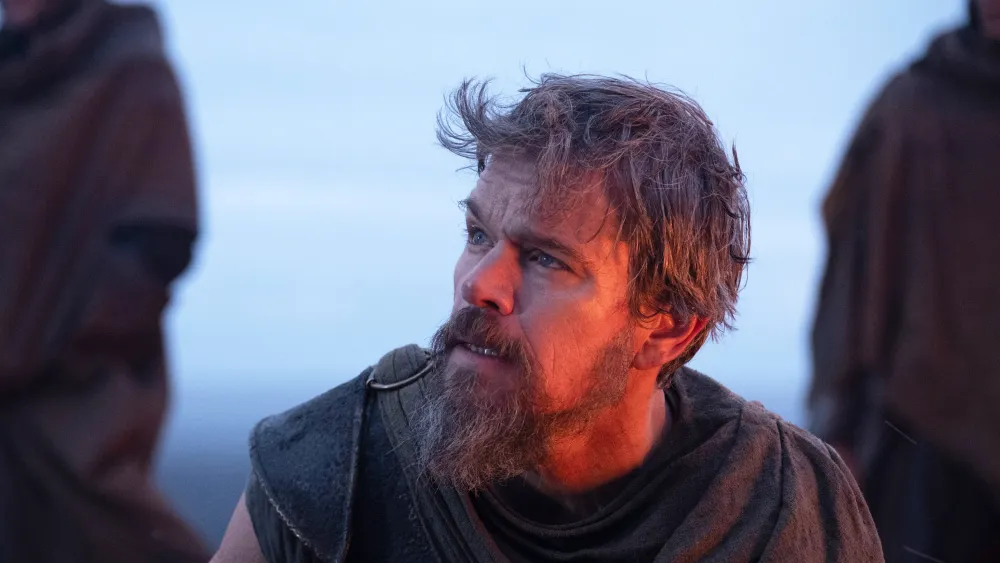
Hero turned exile, Odysseus must return home to Ithaca after a raging victory against the Trojans. But left physically and psychologically stranded, twenty years of hunger and death have passed away from home, underscored by cinematographer Hoyte van Hoytema’s IMAX images of pure isolation stretching to an impassable infinity.
Back on Ithaca, Odysseus’ wife Penelope (Anne Hathaway) and son Telemachus (Tom Holland) are similarly under political siege in their palace, now overrun by suitors vying for Penelope’s hand with a monstrous ambition to take Odysseus’ place.
Monstrosity, Nolan shows, manifests both mythically in the creatures Odysseus encounters and internally in those he must defeat. Battle sequences against a Cyclops of pure megalophobia or the armoured Laestrygonians thunder against the quiet horror of encountering the enchantress Circe (Samantha Morton), whose internal monstrosity to turn Odysseus’ men into pigs is marked by distrust for humans and self-defence.
Meanwhile, at home, lead suitor Antinous (Robert Pattinson) pursues Ithaca’s throne with a chilling contempt for its true king, while even Odysseus himself—wrecked with grief and guilt—contends with the horror he unleashed upon Troy.
Less strong, to the dismay of Homeric purists, is Nolan’s depiction of the sirens or the nymph Calypso (Charlize Theron), the latter holding Odysseus hostage on her island for seven years despite being portrayed more so as his saviour. Even less is said about the unwilling sex part. In fact, Nolan’s women once again in The Odyssey, perhaps besides Penelope, have blink-and-you’ll-miss-them roles, like Zendaya’s performance as goddess Athena, whose ghostly omnipresence acts more as Odysseus’ guilty conscience than anything to do with her divine roles of wisdom or warfare.
Odysseus’ guilt, we soon learn, comes from destroying the Trojans for entirely trivial reasons. Before embarking for Troy, Odysseus reveals to Penelope that the cause of the imminent war was Trojan prince Paris’ elopement with Helen (Lupita Nyong’o), the wife of Menelaus (Jon Bernthal), brother of Greek king Agamemnon. A bit of pre-reading might have been necessary, especially with a choppy, time-hopping exposition, but Nolan clearly had no second to waste with an only three-hour runtime to hand.
This elopement, for Dark Knight-esque Agamemnon (Benny Safdie), was a good enough excuse to destroy a nation in the name of seizing Trojan trade routes. Sound familiar? Nolan leans heavily into parallels between political exceptionalism and trivial warmongering to bolster economic strength taking place offscreen; themes similarly explored in Dunkirk (2017) or his previous three-hour feature Oppenheimer (2023).
Dragged into a war puppeteered by political ambition, both Odysseus and the titular Oppenheimer are tormented by the guilt of mass destruction from the hands of their own intelligence. Like Oppenheimer’s A-bomb, Odysseus wins the Trojan war with tactical deception, tricking the Trojans into dragging a huge horse statue half-buried in the sand into city walls, only for its victims to find it filled with an ambush of Greek soldiers.
Because of this, Odysseus conquers Troy at the cost of breaking Zeus’ law, fatally dooming each of his soldiers while his punishment is that he cannot save them, no matter how hard he tries. To finally return home, Odysseus must ride the waves of fate, surrendering his hubris to the power of the Gods.
Was The Odyssey Nolan’s best? No. There’s plenty to say about poor historical accuracy, overworked action sequences sacrificing emotional depth, and nothing particularly “Nolan” to write home about. (Besides the subtle twist that it was not “people from the sea” who overthrew Ithaca as Penelope feared, but her husband—in another clever disguise—reclaiming his throne instead).
Regardless, The Odyssey is another thundering triumph of Nolan’s filmmaking, this time raging at our absurd political playground on an enormous IMAX screen we cannot turn away from.