The ‘Femme-enfant’
Culture24 August 2026
AuthorDaisy Williams
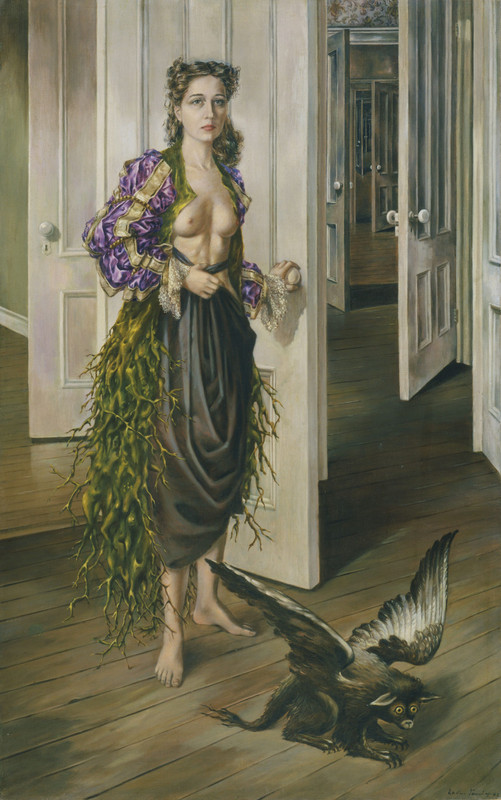
Photos Dorothea Tanning, 1942
How the Surrealists' obsession with Lewis Carroll's Alice split down gender lines, and what Dorothea Tanning did to reclaim it.
A
divide between the Surrealists can be seen through their presentations of women. One could argue that biological difference is the main factor in this divide- the men could only represent the female gender as separate from their experienced reality, whereas the women lived it. The femme-enfant archetype sits at the centre of this divide, and reveals just how differently male and female Surrealists approached the same subject. But what were each gender trying to achieve in their representations of women, away from simply aesthetics and beauty?
What is the Femme-Enfant
An important source of inspiration for the movement was Lewis Carroll's 1865 novel 'Alice in Wonderland' in which a young girl follows a rabbit down into a surreal, nonsensical world which represents the confusion of the transition between child and adulthood.
This inspiration led to the archetype of 'the woman-child', or 'Femme-Enfant' which describes an idealised projection of a woman who is both pure and naive, as well as mature in their adventurous sexual nature. Compared to earlier innocent depictions of the nymph in art history, the Surrealist's 'Femme-Enfant' combined both worlds of rebellion and enchanting playfulness, inspired by Breton's early manifesto which stated that the minds of children "know no bounds" and can therefore be used to communicate the movement's fixation on the fantasy and the limits of the imagination. Two surreal artists who work well as a comparison are Max Ernst and Dorothea Tanning.
Max Ernst
Ernst often had relationships with women younger than his age, such as Leonora Carrignton (26 years younger than him) and Tanning herself with an age gap of 19 years. The two first met in Tanning's studio in New York and bonded over her self portrait 'Birthday' which he claimed as her 'birth' as a Surrealist artist. Within a week, the two began a relationship and moved in together, despite Ernst being married at the time.
Ernst saw a likeness between the character Alice and his earlier partner Carrington, inspiring him to procure two portraits of her titled 'Alice', one in 1939 and the other in 1941. The piece from 1941 is the most famous due to the revolutionary Surrealist technique of Decalcomania which was used. This can be seen in the textures which connect the depicted female body with nature in an intimate and almost private manner. This technique involved spreading a thick layer of paint over the canvas, before a cover (such as a pane of glass or sheet of paper) is added whilst the pigment is still wet to lift some of the liquid, revealing a pattern similar to the texture of moss which, if painted by hand, would take a long time to replicate.
However, the softness suggested by the natural elements is subverted through studying his inspiration. The title ‘*Alice*' anchors the nude female within the work, suggesting that her formed figure is supposed to be the grown version of the child from Lewis Carroll's novel- whilst he has not explicitly painted an underaged girl, a sinister intent can still be seen in his fantasy projection of a character who was intended to be immortalised as a child.
The 1939 portrait appears even more sexualised, as the female-bird hybrid (his view of Alice) is seen to be attempting to escape the feathered body. The form however draws attention to and frames the intimate parts of her body which cannot be argued as a child: she has been transformed into a developed woman. Whilst it could be argued that Ernst was depicting the somewhat appropriately aged woman (Carrington) who he was in a relationship with, the title of 'Alice' and connection to her childish wonderland cannot be ignored. The Surrealist aim to depict dreams and desires could be interpreted to show his fantasy of wonderland, and how he has perhaps trapped Alice in the surreal world and allow her to develop into a grown woman.
Dorothea Tanning
We have to turn to the female artists of the movement to restore our faith in the innocence of Wonderland. Dorothea Tanning often used motifs such as hallways with repeating doors, uncanny domestic spaces and obscure objects to draw inspiration from the fairytale, however, most importantly she used images of young girls (inspired by Alice) to create a subversion to the male sexualisation of childhood innocence.
In her painting 'Eine Klein Nachtmusik' (1943) the surreal Wonderland is created by the magical encounter between the girls set within a standard and familiar hotel hallway which draws inspiration from the mundane environments that bored and suppressed her during her own childhood. Her response to the masculine idea of the 'femme-enfant’ can be seen in her depictions of the young girls, specifically the one whose body can be seen exposed to reveal curves which are similar to that of a grown woman.
However, instead of developing their bodies as an expression of sensual fantasies, objectification and blatant sexuality, Tanning used these women-children in a way to explore the emotional complexity experienced by girls as they develop into adulthood. This can also be shown through the troubling scene in which they are trapped as they physically combat the pressure of the outside elements (the flower) and their inevitable blossoming into adult sexuality.
The fear of adulthood is also presented through the crack on the wall, suggesting the threat of outside sources attempting to destroy their innocence. The significance of the only source of light coming from the furthest door could symbolise a path which they girls need to take in order to find safety, perhaps deeper in the subconscious of their childish imaginations to be protected from the objectification of men.
The Contrast
The differences produced by the contrasting artists boils down to their consideration of the female gender. Male artists throughout the whole of art history have used art as a way to depict their fantasies of the female body, and the Surrealist focus on subconscious desires only enhanced their justification in creating degrading pieces of work. However, the increased female contribution to the field of art as a whole within the 20th century led to works being made to highlight inequalities and combat stereotypes which have so often controlled the narrative. Dorothea Tanning is an example of this, specifically through her way of transforming the same sources of inspiration used by the men within her circle into scenes of resistance against the realities which they were creating.