He Called Me Delicious, I Hope He Meant Delusional
CultureCulture13 September 2026
AuthorGrace McLoughlin
Sunkissed beneath the dwindling summer sun, September leaves us with the last luminary of Leo season: courage, resilience, and a little delusion.
O
n young expectation and opportunity: as a summer baby, my cravings for warm glow, glimmer, and gleam usually fall short by disappointment, by the pressure of collecting evidence of a radiant season. I curate a summer of sociability for my Instagram archives: late evenings compressed into carousels, proof of a summer sufficiently lived yet leaving little space for me to saturate in the fulfilling comfort of my own delusion.
Now, in the same exhaustion with which summer seems to loosen its grip, the sun takes a shorter journey across the sky. Its arc feels tired, almost weak, slipping away earlier each evening and golden hours becoming something we must catch.
There is a kind of young woman who exists everywhere in our cultural imagination: barefoot in someone's kitchen, perpetually sunburned, slightly self-destructive and sexually liberated; she drinks warm beer at parties, falls into beds, falls in love accidentally, turns her mistakes into stories. She exists in weird-girl novels and teenage sitcoms, in coming-of-age films and the photographs we are expected to recreate for ourselves. Her youth is supposed to be messy, erotic, sociable. She is supposed to be wanted.
The sex appeal I am expected to perform in summer feels awkwardly distant from the cosy narratives I want to be the protagonist of:
'You look delicious,' asserted a man; greedy eyes scrounging through the evening August air.
I hope he meant delusional, I thought whilst cringing at the language of heterosexual desire. Through his raspy attempt at seduction, I could only hear his hunger, as if a woman could be looked at and perceived as appetite. Forgive me for not being flattered by his desire, but there would have been something erotic if he saw my belief that my own energy is enough to pull the world towards me.
While women have historically been pathologised for imagining beyond the reality permitted to them, delusional suddenly sounds much more complimentary than delicious. Once an accusation, once a diagnosis, once a way of declaring that someone's perception of reality could no longer be trusted, the word now tells me something about the size of the world I am willing to imagine for myself. For centuries, the acceptable architecture of female adulthood was remarkably narrow in which women succumbed to her fate: a daughter, a wife, then a mother. Progressive ambition lacked intent when marriage and family organised female aspiration- and when women were permitted to think, both futuristically and selfishly, it was often within the boundaries of usefulness. She wanted to be educated, attractive, accomplished enough but towards a life whose destination had already been mapped. For all its crystals, vision boards, and suspiciously well-lit TikTok's, contemporary manifestation has given women the belief that they do not have to be passive towards their own futures.
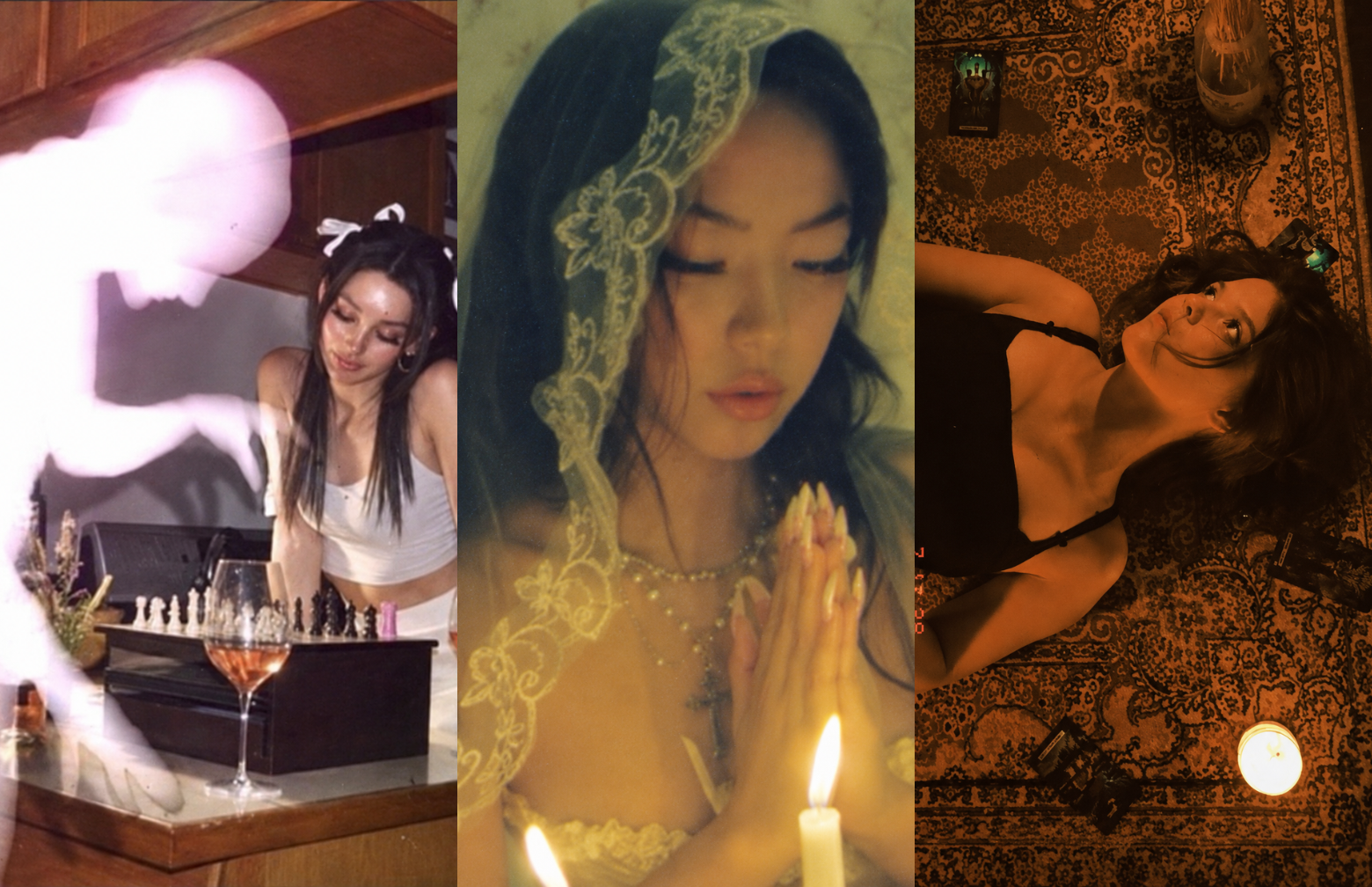
And for tarot, there is an empowering intimacy of asking a deck of illustrated cards to imagine a future in which something good might happen to you. For the few minutes in which you lay the cards across the table, you entertain a future in which the answer is yes. The Star can appear and you can let yourself imagine healing; the Sun can appear and you can briefly inhabit the possibility of joy; the Ten of Cups can make domestic fulfilment look less like an obligation and more like something you might actively choose. Even the High Priestess, who tells us almost nothing, offers a different kind of reassurance: you do not have to know what happens next to believe that something exists beyond what you can currently see.
I actually experience any tarot readings with a cherished affection towards the High Priestess, seated between her two pillars, veil falling behind her, holding the scroll of knowledge. I recognise a familiarity in her position to represent knowing, trust, and feminine authority that doesn't fall into typical divine narratives of motherhood, seduction, and beauty. Gen-Z's 'delulu' trend means our media encourages women to imagine a future with less restraint, allowing vulnerability or embarrassment to be overcast by hope. The woman asking whether her career will succeed is allowing herself, perhaps for the first time, to picture success as something that could belong to her rather than something reserved for the more talented, more connected, more fortunate woman she has always assumed is standing somewhere just ahead of her.
I actually experience any tarot readings with a cherished affection towards the High Priestess, seated between her two pillars, veil falling behind her, holding the scroll of knowledge. I recognise a familiarity in her position to represent knowing, trust, and feminine authority that doesn't fall into typical divine narratives of motherhood, seduction, and beauty. Gen-Z's 'delulu' trend means our media encourages women to imagine a future with less restraint, allowing vulnerability or embarrassment to be overcast by hope. The woman asking whether her career will succeed is allowing herself, perhaps for the first time, to picture success as something that could belong to her rather than something reserved for the more talented, more connected, more fortunate woman she has always assumed is standing somewhere just ahead of her.
In his complimentary pursuit for my attention, I knew the guy this summer meant delicious because the male-mind typically follows the old logic that the latter would be insulting. The tarot cards that appear on my Instagram return to a man in my DMs: you're not one of those girls, are you? they have asked with the faint amusement reserved for women who appear to take their own interior worlds too seriously. The type of question that makes me realise that the distinction between delicious and delusional shows a distinction between the male and female gaze beyond its usual application to the body. The male gaze rarely asks what a woman wants for her life, rather prioritising what she offers, what she looks like, how she appears. It can accommodate an extraordinarily beautiful woman, an accomplished woman, even an ambitious woman, provided that these qualities remain available to observation. A woman's success can become another aesthetic: the impressive job, the expensive dress, the cultured conversation, the beautiful apartment, the evidence of a life that looks enviable from across the room.
Yet, on the contrary to the reductive identity that is associated with my ‘egotistical’ aspiration, I am a woman who has been given very little. If I followed realism as a superior value, I can only imagine becoming grateful for a job that exhausts me, staying in a relationship that disappoints me; mistaking the limits of the present for the limits of the possible. This is where delusion, in its contemporary and deliberately unserious form, begins to interest me. The delulu girl knows that she might be wrong, playing with the possibility of being unreasonable, because reason has so often been used to teach women restraint. She says he will come back when there is no evidence that he will; she calls herself lucky before the good thing has arrived, she listens to Ariana Grande singing just like magic and, for a few minutes, permits herself to behave as though desire might be generative.
I am able, even in the most committed state of my delusion, to understand that none of this means I can manifest away a housing crisis, think myself out of structural inequality, or write abundance in a journal until the material conditions of my life obediently rearrange themselves. Imagination has never been a substitute for money, education, safety or political change. There is a political difference between entitlement and expectation, between believing the universe owes you the life you have pictured and refusing to believe that the life you have been handed is the only one you are permitted to desire.
The legacy of this strange cultural moment, then, should not shame the women believing the universe can give them everything they want, but celebrate the women who became a little less willing to apologise for wanting a life large enough to imagine.