Two Overlooked Surrealist Artists I Wish I'd Discovered Sooner
Art & Culture5 July 2026
AuthorDaisy Williams
Surrealism is often defined by the famous names of Salvador Dalí and Max Ernst, but many artists have been left out of its history. Here are two overlooked figures whose work deserves far greater recognition.
W
e all recognise Surrealism through artists like Salvador Dalí and Max Ernst. Yet countless overlooked Surrealist artists remain absent from the story we've been told.
What is Surrealism?
Surrealism was an artistic movement that emerged in Paris during the 1920s, exploring dreams, the unconscious and the irrational as sources of creative inspiration. Art history has largely centred on the Paris-based Surrealists, who followed André Breton's manifesto and believed the unconscious could reveal hidden desires and truths. But Surrealism was never confined to Breton's inner circle. Many artists explored the same dreamlike, subconscious ideas without ever officially belonging to the movement.
I want to introduce you to two artists I only discovered recently. Their absence from the version of Surrealism I was taught reflects the art world's long-standing neglect of female, queer and non-European artists, a perspective I'm trying to challenge as I continue learning about art history.
Lionel Wendt: Reimagining Surrealism beyond Europe
My first example is the photographer Lionel Wendt, whose work within the 1930s and 40s aimed to create a new identity of modernism within Sri Lanka (previously called Ceylon), as the country was on the brink of independence from British colonialism. The Parisian narrative seeps in through comparisons made to Man Ray, whose solarised photography is often said to be a source of inspiration for Wendt’s work. Yet Wendt's work reached far beyond the Surrealists' fascination with the unconscious. One example is the piece Untitled (A Nude Male Portrait), showing the nude back of a male model.
Whilst the portrait does contain themes of sexual desire, Wendt was also aiming to contrast the documentary style images taken by the British at the time which were used to show their colonial ‘discoveries’- he achieved this through the use of the modern solarizing photographic technique.
His photographs also explored his queer identity on his own terms, rather than through the European frameworks that have come to dominate discussions of sexuality and art. Images such as At the Pottery, Child of The Ocean, and On a Coconut Estate combine the contradictory styles of Surrealist techniques (such as photomontages, repetition and harsh contrast) with documentary realism. The effect of his unique style is a disruption of the British’s attempt to constrict the land and culture into their colonialist ideas, since queerness is instead presented as natural and crucial in the environment’s development.
Wendt’s representation of tradition and social collaboration also aimed to subvert stereotypes attributed to South Asian countries, as well as showing a country striving with the possibility of independence, which was later gained in 1948.
Leonora Fini: The artist who refused labels
I can't believe it took me so long to discover Leonora Fini. Her style expanded across a large range of fields, costume design and theatre set design, yet her work is still too often overlooked. This was especially shocking to me because of her close relationship with the Surrealist group- her fate of falling under the radar is likely due to her rejection of categories, including both ‘Surrealist’ and ‘Female Artist’; “I never saw the point of being part of one group… I prefer to walk alone” (Fini, 1994).
Her dismissal of labels perfectly embodied the aim of Surrealism, since she found her own way of using the unconscious to create art away from worrying about fitting the style of a partial movement.
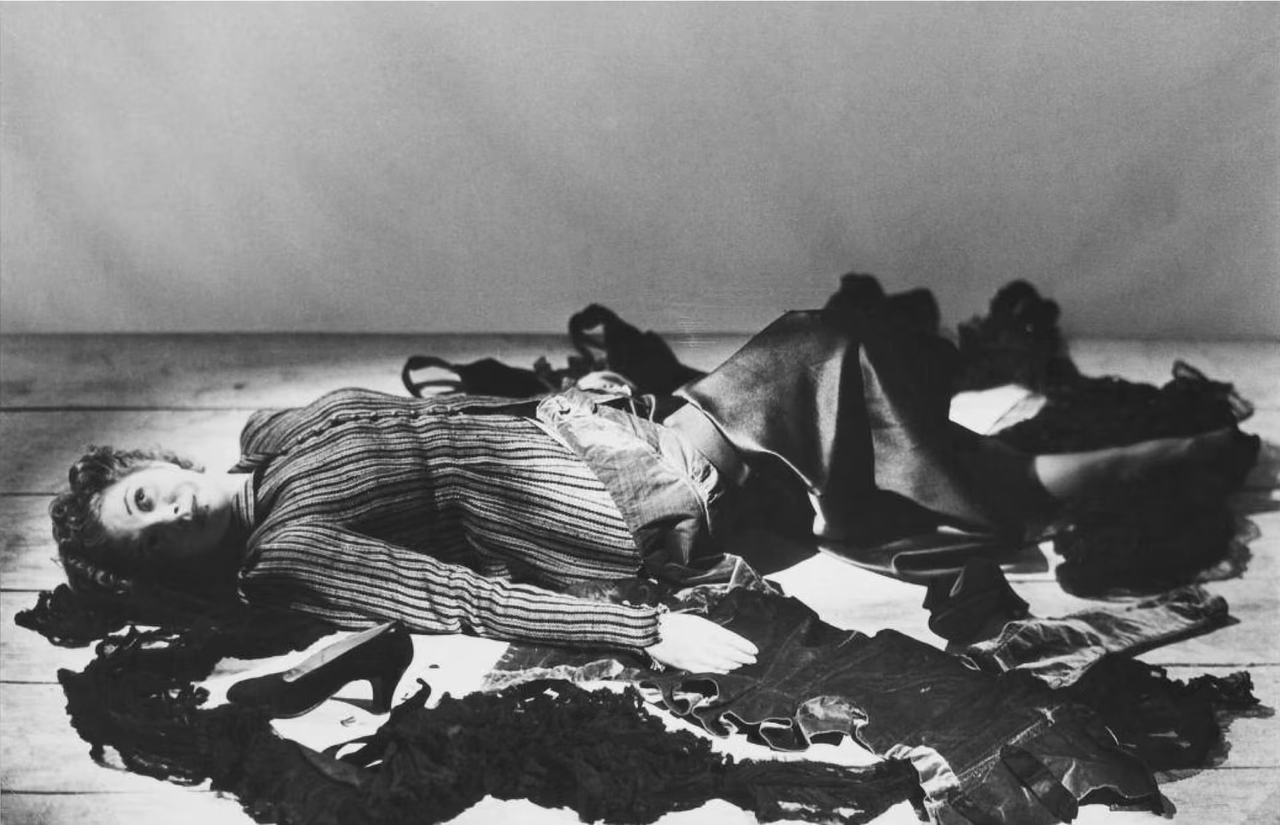
Fini represented ‘the surreal’ away from Breton’s strict rules and fetishisation of the female body, both through her paintings, but also her love of dressing up. The image taken by Dora Maar shows her to be lying in a pile of cast-off clothes, acting as a reflection of her frequent transformations into different identities through the use of fashion.
My favourite of Fini's creations are her hybrid identities. She often played with the liminal space between human and animal, in particular the sphinx (lion) and bird. The sphinx allowed her to balance a masculine and feminine identity, away from the submissive roles applied to women by the male Surrealist gaze. On the other hand, transforming into a bird by decorating herself in an array of feathers allowed her to remain free from set standards of living; she could metaphorically detach from the Earth. Fini challenges art history's tendency to organise artists into neat movements and periods. Her work reminds us that creativity rarely fits comfortably into categories, and perhaps that's exactly what makes it so enduring.
If Surrealism has always meant Dalí's clocks and Magritte's bowler hats to you, Lionel Wendt and Leonora Fini are the perfect place to start expanding that picture.