Painted sculptures by Ron Isaacs, and their fossilisation of childhood
Culture7 August 2026
AuthorDaisy Williams
Ron Isaacs spent 30 years as a painter before creating hyperrealistic sculptures from birch plywood. What do they reveal about childhood, memory, and the objects we leave behind?
W
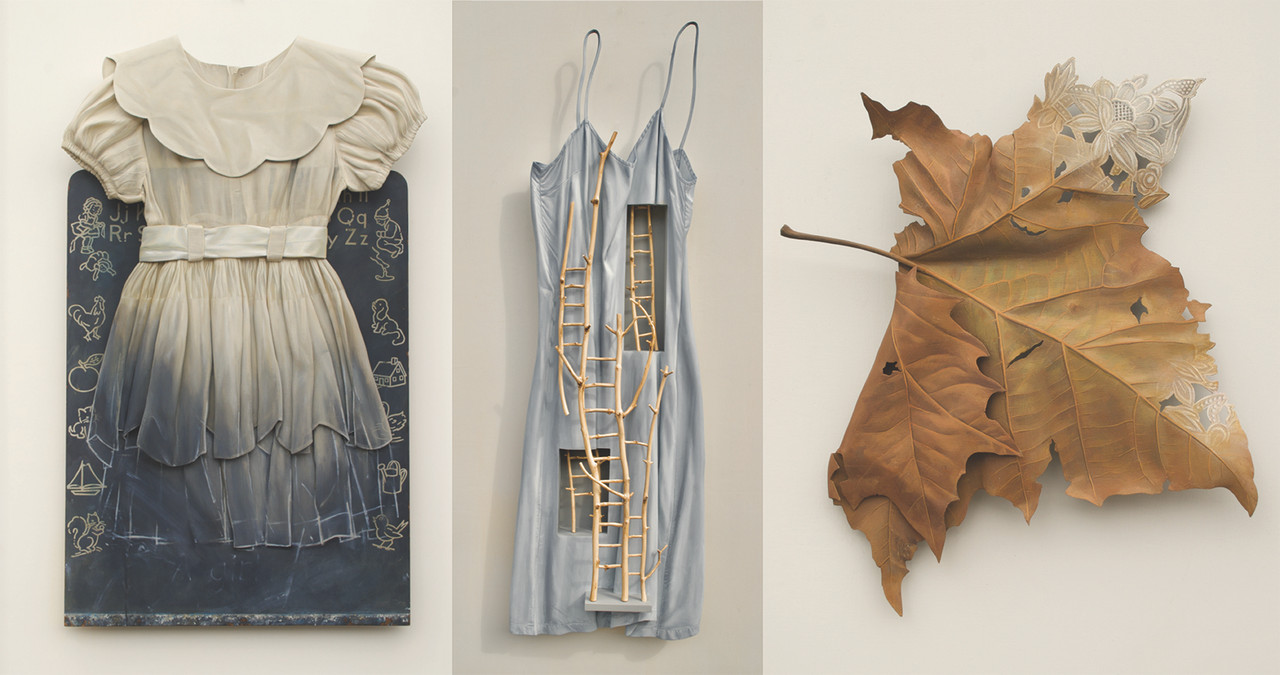
hen I first saw the sculptures made by Ron Isaacs on a Youtube tour of American galleries, I thought that the shapes that I was seeing were perhaps old clothes and objects cast in resin to be easily hung on the wall of an exhibition.
I then thought perhaps they were made out of clay, or another common material used by sculptors. However, the surfaces of his work seemed too realistic and clean of imperfections, such as finger prints or other marks indicating human manipulation.
n reality, each different texture of Isaacs work is made of birch plywood. The artist trained, worked and taught as a painter for over 30 years of his career which supplied him with the ability to manipulate surfaces and colours to create hyperrealistic, but false, images which he labelled as painted constructions that ‘fool the eye’.
Wood is turned into cotton, petals, animal fur, plastic, feathers, and even back into wooden sticks, “creating tension between what the eye registers and what the hand would discover”.
He commonly uses motifs of vintage clothing paired with found and natural objects with the aim of creating a connection between the past and present. I see this through the idea of decay within his work: the leaves that seem to grow from within the garments create a haunting and unsettling feel, as if we’re seeing items frozen in time, left behind in an abandoned house.
The use of feminine, masculine and children's clothing also creates a nostalgic representation of the development of clothing trends through different eras, and how fashion of the past seems out of place preserved so well in the form that Isaac has created- we are used to seeing them in cracked vintage photographs, dust antique stores and grainy old television clips.
In an interview Isaac stated that he “never actually made it to three dimensions; I seem to have stalled at two and a half”
This is seen in how, despite the meticulous curves, drapes and pleats, the clothing still appears flat and empty, lacking the body which naturally allows for the item to be seen from all angles.
The inability to reach the 3D to me reflects a childish perspective of clothing and coming of age. The memories of seeing my mother's dress hung on the door of her wardrobe before a special event- ‘one day I’ll too be able to dress like a woman’. However, these trends have been left in the past, and I no longer have the same desire for her fashion.
‘Improve Each Shining Hour’ in particular reminds me of the children’s game ‘Operation’, in which a pair of tweezers would have to be used to carefully remove objects from the figure of a man laying on a hospital bed- a game which looks like it would become boring fast, but instead taught us to move slowly with a steady hand.
In Mythologies, Roland Barthes’ essay titled ‘Toys’ explored how the then-new trend of children’s toys were bound to have a negative impact on the development of children’s creativity. I was particularly struck put his pointing out that "current toys are the product of chemistry, not nature.” Synthetic materials allowed for a larger range of toys to be produced, however, perhaps this made each one less special?
In contrast, Isaacs sculpture lacks a literal human body, and simply shows the discarded shell of a woman. Maybe it could be argued that this causes us to forget humanity and ‘care’. However, the object of the scissors in replacement of limbs creates a tone of harm, and causes us to speculate what the sharp blades are trying to represent in comparison to the spotted cloth. Moreover, the artist’s process of sculpting and choice of wooden material is designed to last and hold value, instead of the plastic and mass produced nature of children’s toys.
Isaacs' process, as documented by Marinaro Gallery, is shown above.