The Trad Wife Has Moved From TikTok to the Bookshelf
Sarah Langan’s Trad Wife and Caro Claire Burke’s Yesteryear turn the internet’s domestic fantasy into fiction. Are we reading for the same reasons we keep watching?
I
have never watched a trad wife video and thought, I want her life. I have, however, watched a woman make butter from scratch, scrolled to the next video of her children running around a chicken coop, and somehow found myself still scrolling twenty minutes later. Maybe I am intrigued, or maybe I hate it, but either way, I am watching - and so are millions of others.
And now, we can look a little closer.
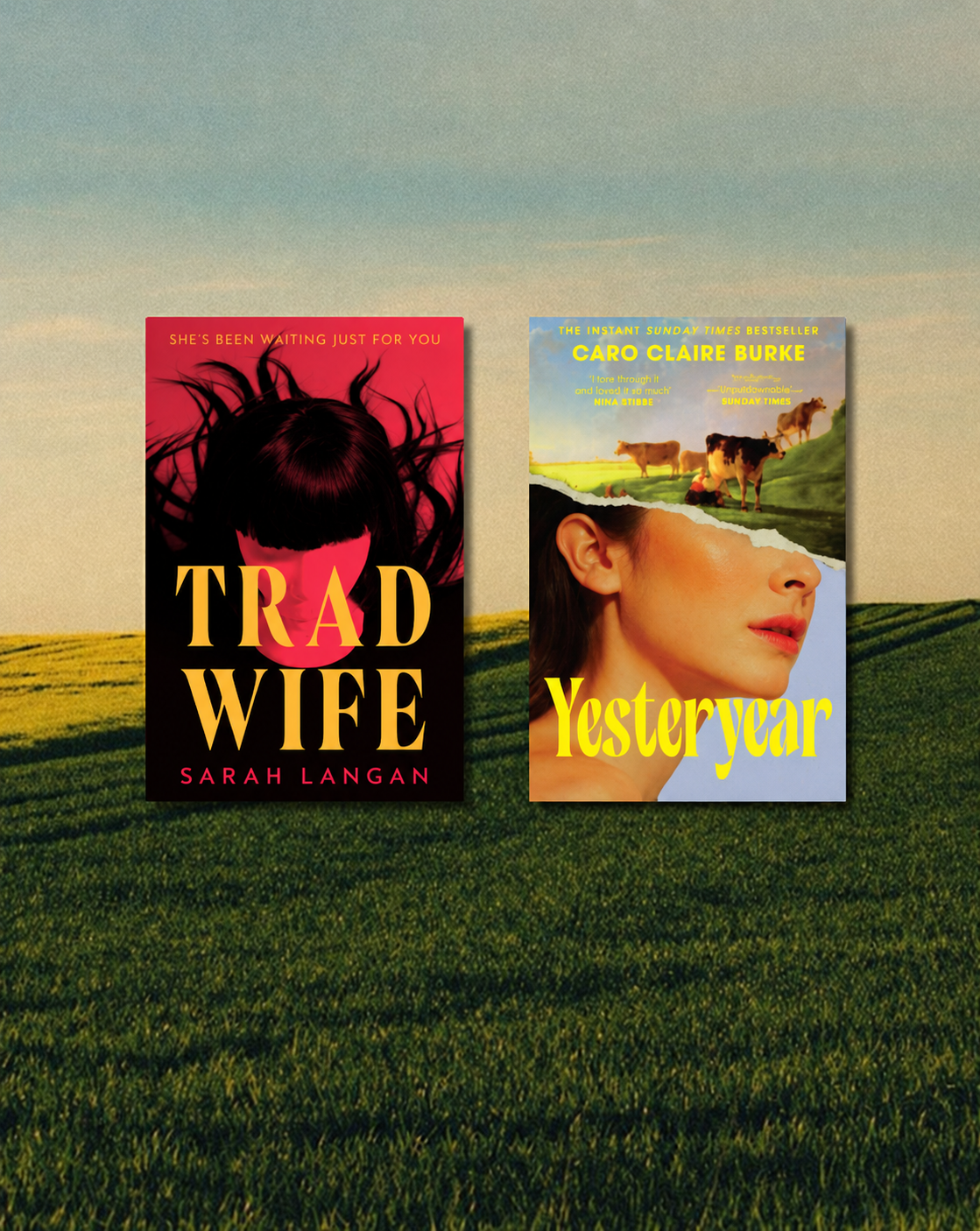
2026 has notably become the year that the trad wife moved from TikTok to the bookshelf, with Caro Claire Burke’s Yesteryear and Sarah Langan’s Trad Wife both turning the online phenomenon into bestselling fiction. Both novels take something that feels almost entirely native to the internet, a niche topic of conversation that only a handful of your friends would already know about if you were to bring it up, and give it the weight of a physical book to be consumed by anyone.
I went into Yesteryear knowing almost exactly what I was going to get thanks to the huge marketing campaign that followed it around a year prior to its release. Its premise is incredibly fresh and promising: Natalie, a successful trad wife influencer, wakes up in 1855 and finds herself having to actually live the life that she has spent years romanticising online. There is something deeply satisfying about it for those of us reading from the outside. The novel flips between ‘modern’ Natalie, a few days prior to her going back in time, and 1855 Natalie, who is confused, scared, and importantly, cannot seem to truly live this lifestyle without the help of a camera crew, babysitters, and personal chefs.
The fantasy works beautifully at a distance; up close, it starts to look rather different. It is a book that you devour in a day or two simply because you cannot look away. Natalie is vain and often deeply irritating, and her ‘modern’ self has to suppress violent outbursts of anger, but she is also funny and compelling precisely because she is so convinced of the life that she has constructed for herself.
Trad Wife took me by surprise with its different approach, as I followed Yesteryear with this ebook hoping to satiate my desire to keep the narrative going. Rather than centring itself on the trad wife, Langan puts the reader inside the mind of Jenny, a journalist who is sent out to Mia Wright’s farm. In the nearby town, people idolise Mia, working for her without ever getting close enough to truly see her. This leaves them obsessed with the idea of Mia, seeing her as a saviour, someone who can do no wrong in their eyes.
As expected, Jenny soon discovers that Mia’s life does not match the idyllic one she shares online, but not for the reasons you’d expect. A sinister horror lies beneath the farm, and as Mia becomes increasingly weak and dishevelled, Jenny begins to experience disturbing dreams and time loss, blurring the line between reality and deception. The pleasure here is not quite in watching the fantasy collapse as it was in Yesteryear, but in wondering, with one eye peeking out through the hands that cover your face, what might be happening beneath it.
What struck me after reading them back to back was that, despite their very different approaches, I was completely hooked by the narratives because I found something so compelling in reading about a woman you are not entirely sure you trust.
This is where I started thinking about the way we consume trad wife content online in the first place. There is a strange contradiction at the heart of it: the whole point of the trad wife influencer is to promote her lifestyle as desirable, and yet so much of the attention surrounding the content comes from people who have absolutely no intention of living that way themselves. I think the trad wife knows this too, and this is where the idea of ragebait comes in.
Defined by Cambridge Dictionary as “information, images, videos, etc. that are put on the internet to deliberately make people angry and to encourage them to reply online,” ragebait has become an increasingly familiar part of the way we consume social media. The things that make us roll our eyes, argue with our friends, or immediately open the comments can be some of the hardest things to scroll past.
Ragebait becomes a primary marketing strategy because anger is attention and attention is one of the most valuable things a piece of content can generate. A trad wife does not necessarily need admiration; she just needs people to keep watching, commenting, and sending the content to somebody else. The same is true of these two novels, as they become almost a literary form of hate-watching.
The more extreme the performance of the lifestyle becomes, the more people want to tell you what they think about it. We don’t really know these women or whether they are truly living this way, but the less we know, the more room there is to speculate, and this is exactly the space that Caro Claire Burke and Sarah Langan have moved into. I wonder now, in hindsight, whether this is why I found both books so difficult to put down. The trad wife is already a character before she appears on the page, as we arrive with an idea of who she is supposed to be and the assumption that that may not be the whole picture. The novels get to play in that gap.
We are used to marketing being about aspiration: buy this because you want to look like her, dress like her, live like her. However, in this case, the authors can rely on an audience that has already been created by social media, and on the curiosity, irritation, and fascination that comes with it. You are not buying the lifestyle; you are buying the opportunity to get closer to it.
For me, Yesteryear had the stronger central idea and the more satisfying relationship between its premise and commentary. I think almost everyone who picked up this book will have assumed that the ‘perfect’ lifestyle that Natalie lives is merely a facade, because that is the commentary that runs alongside these narratives online and in print, and so I found it intriguing that Burke differentiated this ‘nothing is as it seems’ narrative by making Natalie a nightmare. She is not a victim of this lifestyle and we struggle to empathise with her because she is a horrible, narcissistic person!
However, I will say that towards the end of the novel, this idea begins to falter as what makes her a compelling character in the first 80% of the book is abandoned in place of an easier, more conventional ending. This, combined with the fact that the husband kept referring to the ‘manosphere’ in a way that felt increasingly unnatural, is what ultimately knocked the book down from five stars to four for me. It felt less like the language of an actual person and more like the novel reminding me what it was about.
Around 60% of the way into the novel, without any prior mention of it, we are told that “the manosphere, he called it, a phrase he’d mentioned in my presence before”, and then again in the last 10%, upon reaching a cabin front door, “a word is etched into the doorframe: MANOSPHERE. So this is where the men go.” It began to feel less like a word that these characters would naturally use and more like a buzzword being repeatedly underlined for the reader. The repetition made the novel feel increasingly conscious of its own subject matter, and pulled me out of the story exactly where I was most invested.
Trad Wife has the opposite problem to Yesteryear. Yesteryear has a premise that should feel completely immersive by taking a woman who digitally romanticises the past and then actually puts her in it. However, in these moments when the language becomes so conscious of the contemporary phenomenon that it forgets what is relevant to itself, I was reminded that I was reading a novel about the internet.
Trad Wife, meanwhile, is unmistakably a modern story. We know there are cameras, content, and an audience tuning in to perform for, yet once Jenny arrives, the book manages to make you feel as though you have stepped backwards in time. The farm becomes increasingly isolated and strange, almost folkloric with its mysterious yellow fog, and blurs the boundaries of ordinary reality.
Whilst I liked that, after being thrust into the family lifestyle as Mia grows unwell and weak, Jenny is forced into the role of trad wife herself, what knocked Trad Wife to 3 and a half stars was that it eventually became so committed to its own weirdness that it began to lose sight of the thing that made it interesting in the first place. There is only so much mileage in the obvious reveal that the perfect life is not actually perfect, and perhaps because the trad wife phenomenon is still so new, fiction has to find increasingly wacky ways of taking it somewhere we have not already been, and Langan certainly finds one.
This book is completely bizarre at points, and while that does not always work, there is something undeniably compelling about a book that commits so fully to its own fever dream. Trad Wife works best as a one-sitting, immersive read. It loses some of the sharpness of its original premise in the process, but it gains a kind of delirious momentum that makes it very difficult to put down.
The trad wife has proved incredibly useful to fiction because she is already a character we have collectively written. Social media has given her the costume, setting, and audience, but the novel gets to decide what happens when the story begins.