Piper Maru on Dreams, Masks and Beginning Again
CultureCulture30 June 2026
AuthorIsabella Pettitt
It's ok to start over. Again and again, if needed. Artist & former set designer Piper Maru talks dreams, hybrid figures, and finding her way back to painting.
I
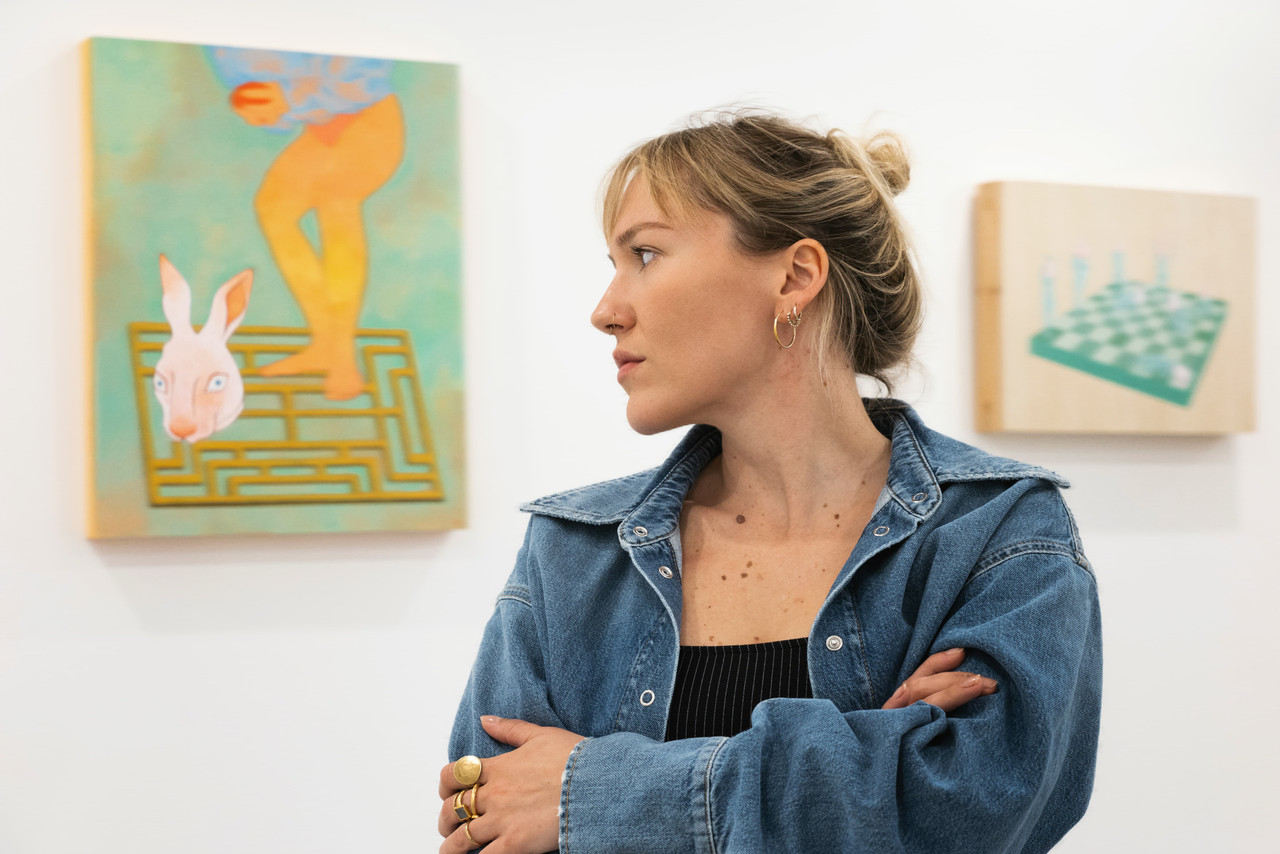
caught up with artist Piper Maru over email this spring, while she was in New York in the midst of her latest show, BEGIN, again. I first came across her art last year, doomscrolling through the endless void of Instagram, and was struck by the fittingly strange nature of the work. To my surprise, I later found out she'd been showing at the Troubadour Gallery in London. Her practice has always lived between worlds - film, costume, ceramics, paint. Right now, it lives between London and New York.
She's spent a lifetime moving through creative forms without ever quite settling for just one, set design, costume, a short-lived but beloved homeware label called Maru Objects, tattoo commissions, and now a return to painting that feels less like an arrival and more like another beginning. Her current work centres on masked, hybrid figures. It's an extension of everything she's done before, filtered through a search for something she calls, simply, joy.
Below, she talks about dreams as a creative well, the spiritual pull of working with her hands again, and why starting over — again and again, if needed — might be the whole point.
Can you tell us a little about how you first got into making art? Was there a moment you knew this was the path for you?
I've been making art for as long as I can remember, it was always in my nature to create things from my imagination. I've been surrounded by hugely creative people my whole life, so I think it was inevitable I'd pursue art in some form. It was never a question of whether I'd do something creative, only which form. I wanted to be a film director until my late teens, then a set and costume designer. It's only recently that I've landed on "fine art". Even now, I'm never satisfied with just one form of making. I don't think I ever will be.
How would you describe your practice to someone encountering your work for the first time?
There's always been an air of the otherworldly and fantastical in my work, that's down to growing up on Studio Ghibli films, and a lifelong fascination with all things mysterious and magical. My current practice is less overtly magical than my earlier work, though it's still rooted in the surreal.
My last two exhibitions have focused on oil and acrylic painting, but privately I also work with ceramics, papier-mâché, and other materials to make three-dimensional pieces. I haven't shown that side publicly yet, but it's in the pipeline.
You've moved through so many artistic practices over your career. How has that shaped the way you think about your work today?
Growing up with parents in film and television industry, there was always a question of whether I'd go into that world myself. After school I went down the set and costume design route, and even though I've since moved away from it, it still heavily shapes what I make now.
I've always loved the idea of being immersed in a foreign world - that was part of what I was trying to do with Maru Objects, my homeware brand: creating items that belonged to a particular world of their own. I do a little of that in my paintings too, but I'm still drawn to push it further, more seriously, which is what my next venture is about.
What does your day-to-day process look like? Do you work intuitively, or plan everything out?
It's a mix of both. Most of my ideas come from dreams or meditation, the place right before you fall asleep is a real well of inspiration. In stillness, the ideas come rushing forward. But once it's time to actually plan a piece, I'm quite meticulous. Right now I'm working with a lot of bodies in space, so the first idea is usually a body in a particular position. I take photos of myself or people I know in that shape, then work out composition and colour on my iPad. Once I'm happy with it, I project it onto a panel and trace it. After that point, very little is intuitive — unless I make a mistake I have to creatively fix.
You've spoken about moving away from digital work and back toward making things with your hands. What prompted that, and how has it changed the work?
I still use my iPad to sketch ideas, but I've moved away from making finished digital work. For years I was making almost everything on a screen – tattoo commissions, graphic design jobs, art prints I'd sell in batches. Digital art is so much fun because you can do things that are much harder, or impossible, by hand. But I got tired of staring at a screen all day, every day. There's something grounding about working with your hands, being physically connected to the thing you're making. It's honestly a spiritual practice, staring at a screen has never felt that way to me.
Painting demands more patience. There's no undo button. So the work I'm making now is a little simpler than before, though that won't last forever as I keep honing the skill and the patience. I do miss making more detailed work.
Tell me about your current show in New York, what was the starting point, and what do you want people to take from it?
The show is called Begin Again. The work I've made over the last few years is much more personal than anything before it — it's an ode to my own search for joy. The title is a reminder, to myself and hopefully to others, that it's okay to start over. Again and again, if you need to.
Right now I'm obsessed with painting figures wearing masks. Sometimes it's unclear whether they're human-hybrids or simply masked, I like leaving that open. The masks represent the ones we all wear to present ourselves to the world: how we hide, perform, transform. I want to show our playful side, the importance of not taking ourselves too seriously. There's still a theatrical thread running through the work.
Looking back, is there a piece, project, or exhibition that feels most significant to you?
During Covid, I stepped away from film and theatre and launched a small business called Maru Objects, a limited-edition art, homeware, and games brand. I poured everything into it, and even though it was short-lived, I'm really proud of the branding and the pieces I made. I realised pretty quickly that running a product business wasn't actually what I wanted to do but the idea of making highly curated, one-of-a-kind objects has never left me.
How do you know when a piece is finished?
Because I plan most pieces in advance, I usually know it's done when it matches the sketch closely enough. But beyond that, it's intuitive. There's always something more you could add, the question is whether it would actually improve the piece. There's real danger in adding too much.
What's next for you? Any direction you're excited about?
I'm in the early stages of something I'm really excited about. I've spent years assisting other artists on mural projects, and now I want to start my own painting and prop-making services. It brings together painting, making, storytelling, and building environments — all the things I love most — so it feels like a natural next step. Still early days, but I'm excited to see where it goes.
Alongside that, and alongside my fine art practice, I've started leading an online women's group called The Creative Shift, a workshop helping women move past creative blocks and rebuild their relationship with their own creativity. I've run two groups so far, with more planned, and I'd love to take it in-person eventually.
Begin Again was on view at KKM Projects, Kinderhook, New York, from May 29th to June 29th.
Follow Piper Maru's work at @bpmarumaru and @pipermaru.art.