Leonardo Devito's work spreads across etching, sculpture and painting. His work contains a signature style of deep colours and figures that balance between 2D and 3D through rendering and surreal perspectives. They seem to belong in an exhibition of classical art, however essences of modern culture through objects, brand logos and clothing silhouettes makes each scene feel eerily familiar.
His work is pure in its references to childhood and adolescence, using memory and the imagination to guide the creation of each scene. Devito's work aims to be personal to both the creator and viewer, rather than purely research focused- methods of chance and automatism (the lack of conscious control) work together to create magical and dream-like scenes. Therefore, his creative process shifts to styles and references that are inspiriting to the artist, but perhaps not picked up by every viewer, such as detailed narratives similar to Renaissance art, or figures that appear Surrealist.
Who Is Leonardo Devito?
Leonardo Devito is an itallian artist living and working in Turin northweastern Italy. Devito's work aims to be personal to both the creator and viewer, rather than purely research focused- methods of chance and automatism (the lack of conscious control) work together to create magical and dream-like scenes. Therefore, his creative process shifts to styles and references that are inspiriting to the artist, but perhaps not picked up by every viewer, such as detailed narratives similar to Renaissance art, or figures that appear Surrealist.
Renaissance and Medieval religious art inspires Devito because of its necessity during a time when many audiences were illiterate, and would therefore access stories visually and verbally.
His paintings become a form of collaborative communication between the canvas and viewer, as he encourages them to project their own ideas and identities into the work.
As Devito explains:
His art invites us to do the same.
Reading Giovedì sera
I decided to try and make sense of the painting 'Giovedi sera' through writing down a description of the work and asking myself 'so-what?'.
Before long, I had written two pages of potential meanings hidden within a painting that at first I found confusing!
I can see that the composition naturally divided into three layers. Whilst it is normal to work from top to bottom, the main character being at the foot of the canvas influenced me to start from the bottom up. The man appears asleep. However, his position also leaves him vulnerable, especially due to the outdoor environment.
It is summer time and I often watch the sun setting on the fields far away outside my window. Devito's painting immediately reminded me of my dream of one day sleeping in the middle of that green and damp space. But obviously that is not normal, and something stops me from doing it.
The two boys on bikes. Their fast movement and hunched postures impose upon the calm man. They both appear to watch him, however he is unaware. Perhaps they represent the danger of strangers and public spaces. Whilst it is very unlikely to meet someone in a field at the dead of night, it is a shared fear that is enough to stop people from staying out all night long, and instead sleeping in their locked houses, hidden behind hallways, doors and bed sheets.
As my gaze rises to the top of the painting, the scene seems to become more sinister. In the context of modern mythology, I associated bats with the dangers of the night, as well as vampires and the supernatural. The blood red moon enhances the idea of magic and bad omens. Perhaps the scene shows Devito's imagination becoming more intense as it unfolds onto the canvas.
The structure as a whole can seem to suggest that the dangers are taking place within the dream of the man, almost like a thought bubble. However, I was also reminded of the style of Renaissance art in which multiple narratives build one overwhelming story through the use of layers and divisions, such as the work bellow by Paolo Uccello.
When I came across Devito's painting I decided to look up the Italian title 'Giovedi sera' which translates to 'Thursday evening'. This quick Google Translate search accidentally brought me to a hidden meaning that I would not have picked up on before, which is that The Last Supper took place on a Thursday evening. The most famous depiction being by Leonardo Da Vinci, which also uses an overwhelming amount of characters and interactions within a single large scale scene. The central figure- Jesus- also appears calm despite the threat of danger and betrayal that is to come.
What fascinated me most was realising how much our own experiences shape the way we read a painting. Researching Devito revealed references I would never have noticed on my own, while my own interpretation was shaped by memories and associations that someone else may not share. His paintings don't ask for one correct answer—they invite every viewer to bring their own.
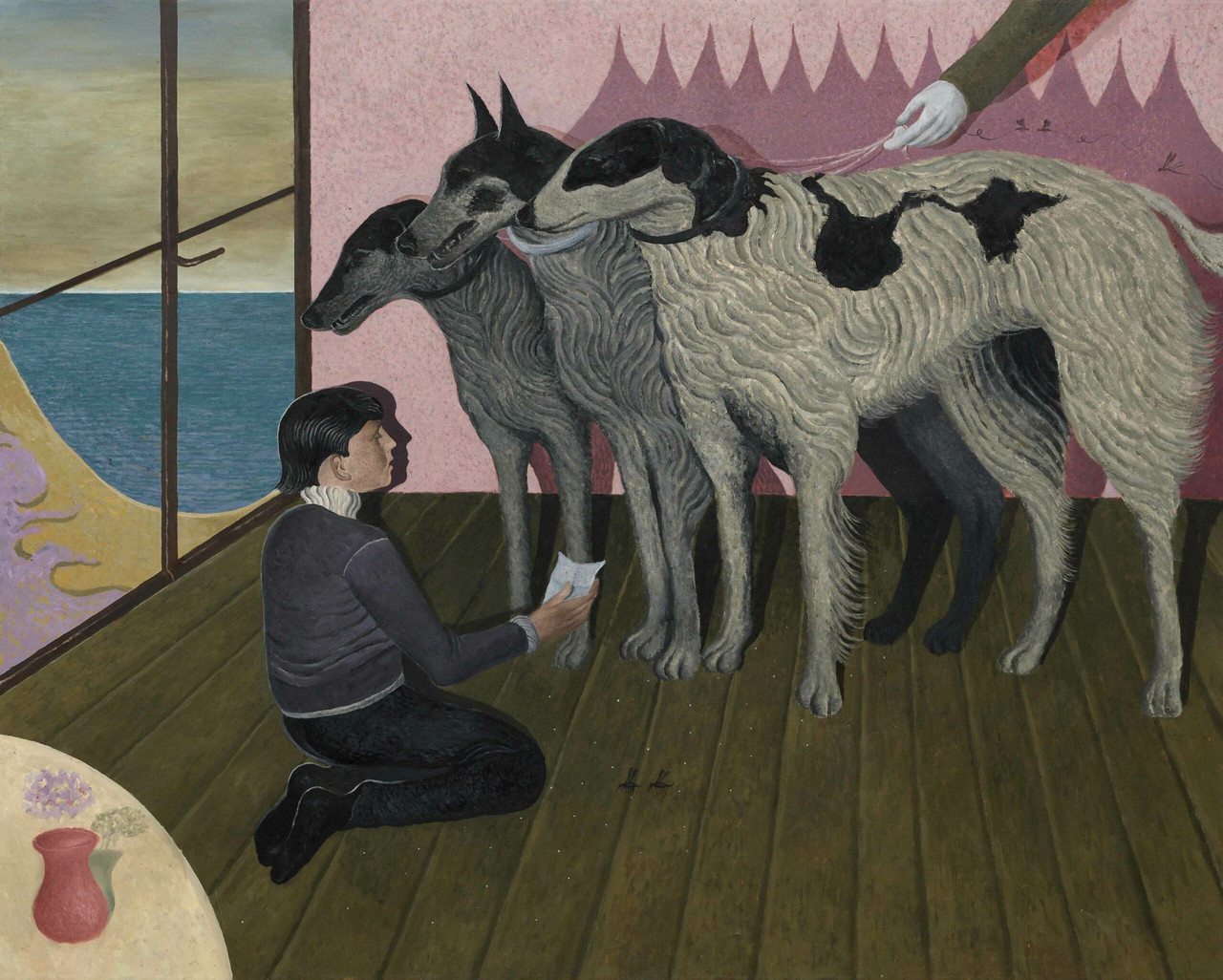
Devito's work could at first appear confusing- how are we to make sense of a small man kneeling before three large dogs? Ask yourself 'So-what?'.
Why are the dogs so large in this image? Perhaps the scale reflects how a child would see this large animals. Why is the view of the ocean behind a glass door? Perhaps the child feels trapped. Or the dogs feel trapped, since they appear squished into the tight room. It's interesting to see what you might find hidden in what appears to be a clear picture.