History in the Making: Everything We Know About The Odyssey So Far
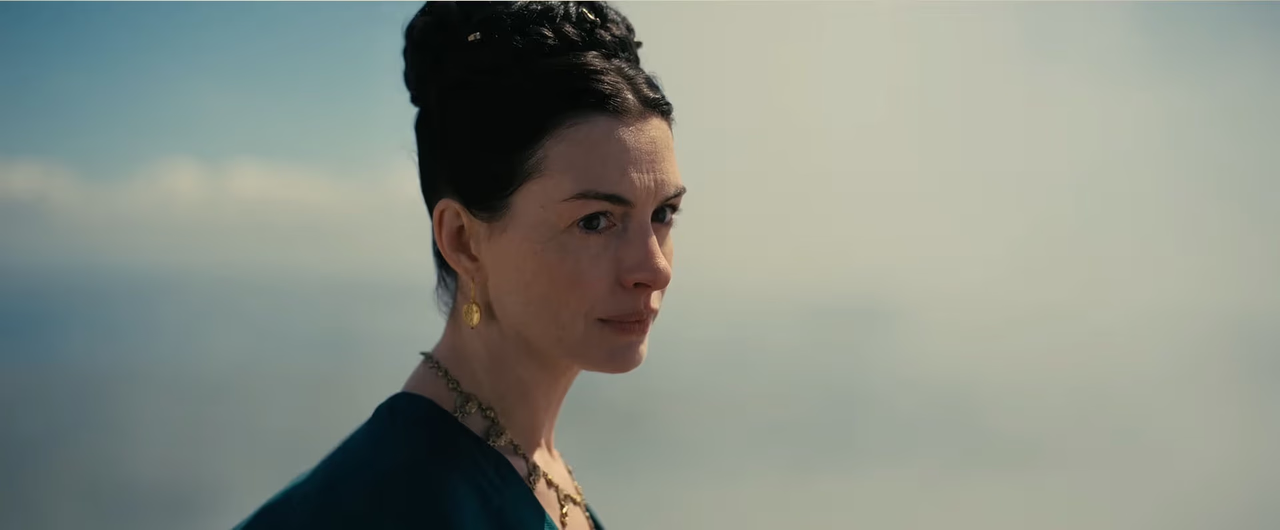
Film & TV9 July 2026
AuthorAlexandra Hill
Christopher Nolan's The Odyssey (2026) has already broken ticket sale records more than a month before the summer blockbuster reaches cinemas—but it has big shoes to fill.
L
ess than a month to go before the release of Christopher Nolan's The Odyssey (2026), and tickets for the summer blockbuster have already turned to gold dust. Nolan’s 13th feature film has sold more BFI IMAX tickets in the first 24 hours they were on sale than any other film to date.
And The Odyssey continues to make history as it becomes the first narrative feature film to be shot entirely on 15/70mm IMAX film cameras.
Over 28,000 tickets flew off the shelves at the UK’s largest cinema screen, generating £750,000 in gross revenue. This doubles the previous record held by Dune: Part Two (2024) which took £366,000, closely followed by Nolan’s Oscar-winning feature Oppenheimer (2023) at £254,000.
But high demand left frustrated fans scrambling as the BFI website struggled under the volume of traffic, with no virtual waiting room in place. The same story unfolded across the pond, where heavy demand disrupted access to cinema websites including AMC.
Since the success of Oppenheimer, demand for IMAX 1570 screenings has reached an all-time high. The three-hour epic snagged the Best Picture, Best Director, Best Lead Actor, Best Score, and more categories at the 96th annual Academy Awards in 2024, pushing IMAX further into the limelight.
Using 70mm film, IMAX cameras run the film horizontally, exposing a frame almost ten times larger than standard 35mm film. Only 40 locations worldwide are capable of IMAX 1570.
Digital may be faster and cheaper, but it is clear where Nolan stands. Going anti-digital meant over two million feet of film was captured across 91 shooting days in the Mediterranean, with cinematography led by Hoyte van Hoytema, who has worked with Nolan since Interstellar (2014).
For those obsessed with Greek mythology, The Odyssey is an adaptation of Homer’s epic poem composed around the 8th century BCE. The story follows the treacherous journey home of Odysseus, King of Ithaca, as he returns from the Trojan War. In the ancient epic, Homer’s hero faces a slew of mythical creatures in the seas separating him from his wife Penelope, who is being pursued by suitors seeking Odysseus’ power.
But box-office buzz is not down to cinematography alone. The ancient Greek epic boasts an all-star line-up led by Matt Damon as the hero himself and Anne Hathaway as Penelope. In a busy summer for the newlyweds, Tom Holland will play Odysseus’ son Telemachus and Zendaya will feature as Greek goddess Athena, before we see them reunite in Spider-Man: Brand New Day (2026) a week later.
Look out for Lupita Nyong'o as Helen of Troy, Mia Goth as Penelope's maid Melantho, and Robert Pattinson as the lead suitor Antinous.
But as anticipation grows, criticism has followed. Since the trailer was released last December, critics have leapt on Nolan’s historically inaccurate costume design and dialogue, while casting Lupita Nyong’o has sparked backlash with a racial charge.
Nolan has instead chosen to lean into our collective imagination of ancient Greece, and there is nothing inherently wrong with that. As many critics have argued, remaining faithful to Homer's themes and characterisation is arguably more important than historical precision—especially given that The Odyssey is, ultimately, a work of fiction.
That said, Benny Safdie's Agamemnon does look as though he wandered off the set of The Dark Knight (2008).