How Camp Miasma's Art Director Brought Glass Matte Painting Back From the Dead
Film & TV29 August 2026
AuthorIsabella Pettitt
PhotosMUBI
Long before CGI, filmmakers painted worlds by hand. Camp Miasma's Art Director Courtney Stockstad on resurrecting glass matte techniques, hiding Little Death in plain sight and the one shot she'll never forget.
I
first watched Teenage Sex and Death at Camp Miasma before its wider release, and left the screening not entirely sure what I had just seen. I knew I liked it — its blood, sex and sheer strangeness were difficult not to — but there was something about it I hadn’t quite cracked. Watching it for a second time, this time following an introduction from Gillian Anderson at the Curzon in Soho, the film suddenly made a lot more sense. And with less time spent trying to work out exactly what Schoenbrun was doing, I found myself looking at everything else.
Camp Miasma is an extraordinary film to look at. Every bedroom, corridor, prop and blood-soaked corner feels like it belongs to a world with a history far beyond what we actually see on screen. That world was partly the work of art director Courtney Stockstad, who after spending much of her career working in science fiction, found herself helping build Schoenbrun’s strange and seductive slasher universe.
Perhaps science fiction isn't as far removed from Camp Miasma as it first seems. Both demand the construction of worlds that don't quite exist, and Stockstad credits years spent working within the genre teaching her how to approach the unusual.
“I have worked in science fiction genre pretty much my whole career,” she tells CHERUB, “which has been a great tool for thinking outside of the box when problem solving creative tasks.”
For Camp Miasma, thinking outside the box sometimes meant looking backwards. Schoenbrun's film may be a contemporary slasher, but its visual language is indebted to the horror films that came decades before it. Rather than sanding away those imperfections with modern technology, the art department embraced techniques associated with filmmaking of the 1970s and 80s.
“We pulled a lot of our inspiration from techniques of the 70s and 80s,” Stockstad explains, pointing to “the glass matte hand-painted backdrops and the unrealistic colour tones of the blood.”
By the time Stockstad joined the production, production designers Brandon Tonner-Connolly and Matt Hyland had already established a precise bank of visual references. “We were very intentional with adding the type of dreamlike visuals used heavily in 70s and 80s film,” she says.
But some of my favourite details are much easier to miss.
Billy (Gillian Anderson), the painter at the centre of the film, doesn't leave her artistic identity at the edge of the frame when she enters Camp Tivoli. Her relationship with Little Death — the fictional slasher franchise she has been tasked with resurrecting — quietly bleeds into the spaces around her.
“We wanted to incorporate as much Little Death into her spaces as possible but in subtle ways,” Stockstad says. “The ceiling vent square shapes were incorporated into various places around Camp Tivoli that viewers may or may not notice.”
Elsewhere, the art department quite literally inserted pieces of themselves into Camp Tivoli's history. In the theatre where Billy first meets Kris (Hannah Einbinder), the walls are supposed to carry traces of campers who passed through decades earlier.
“The theatre where Billy and Kris first meet is meant to have wall art from past campers likely in the 80s or 90s,” Stockstad explains. “Our art department added photos of some of us in the 90s to help make it feel more realistic.”
So somewhere inside Schoenbrun's fictional decades-old horror universe are photographs from the very real adolescence of the people who built it.
Long before those details reached the screen, however, they existed as possibilities. Stockstad's background stretches across fine art, communication arts, illustration and graphic design, skills that became particularly useful when translating the film's ideas into something everyone could actually see before construction began.
“We put together a large amount of mock-ups to present visual options for Jane, Brandon and Matt to choose from before we started building anything,” she says.
For a film so preoccupied with resurrecting the mythology of an old summer-camp slasher, it's fitting that making it apparently began to resemble summer camp itself.
“It felt like summer camp with friends!” Stockstad remembers. The crew, many of whom barely knew one another at the beginning of production, stayed in the same hotels and spent their weekends exploring Vancouver Island together. “I have made a lot of lifelong friends and am very grateful for that.”
There is one piece of Camp Miasma though, that Stockstad doesn't hesitate to single out.
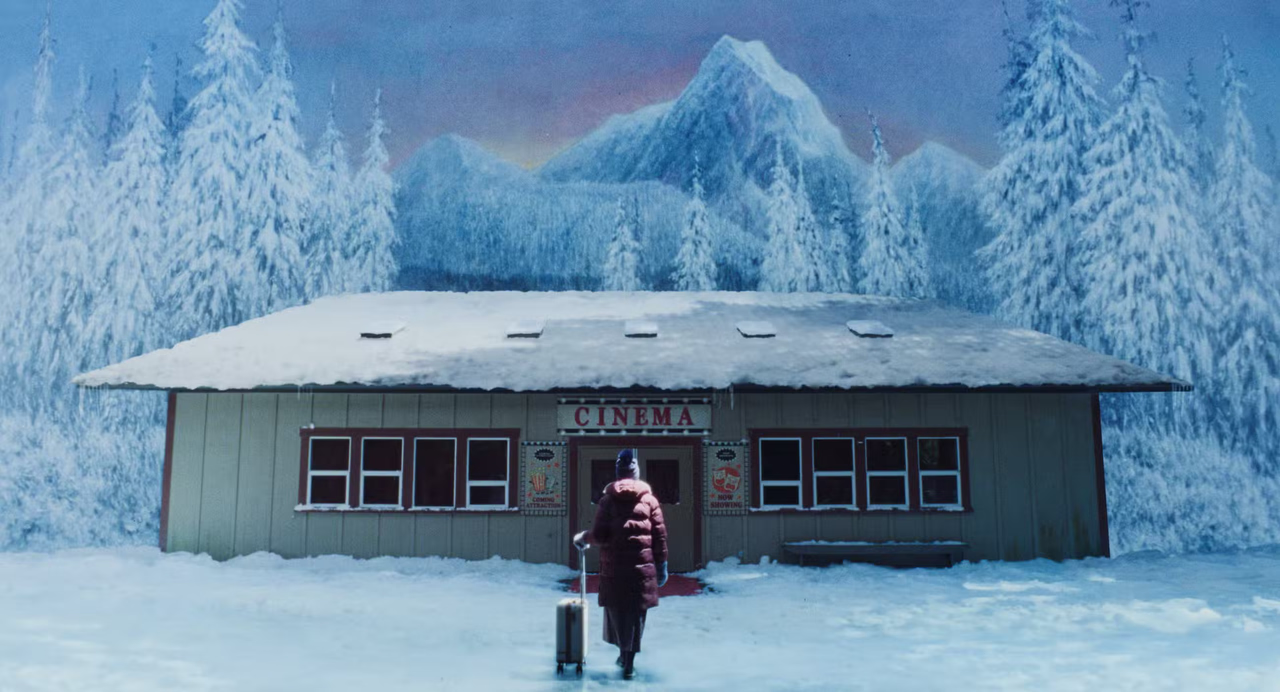
When Kris first sees the exterior of the theatre, what appears on screen is the culmination of a process that lasted for almost the entirety of Stockstad's time on the film: a glass matte shot she and Matt began working on during her very first day on the production. They were still working on it when the production was nearing its end.
“We only had one shot to get it right,” she says, “and it was incredibly exciting to see it all line up perfectly.”
After spending weeks recreating a technique belonging to another era of filmmaking, everything had to physically align in that single moment. It did.
“I think there is a video that Matt took circulating around the internet of that moment,” Stockstad says. “We were all smiles that day.”
And maybe that's what became so apparent to me on that second viewing. Camp Miasma is a film about trying to resurrect something supposedly left behind, an old franchise, Little Death the old way of making movies. Look closely enough and that resurrection isn't only happening in the story. It's built into the walls.
.jpg)