After taking the time to decompress and deeply evaluate the designers at the helm of Paris Haute Couture Week Fall/Winter 2026/27, I was left in awe. I truly believe not one designer left that stage without feeling empowered.
Many believe that fashion is mere fabric draped on one’s body. It is nothing more than a t-shirt or denim jeans, yet that is where the creativity lacks. Fashion has long been a playground for creativity to erupt. A destination for character to find itself infused with culture, art, and history, and Paris Haute Couture Week is exactly that. An event only the most valuable fashion houses can be a part of is more than a showing of clothing on models. It is an execution of sculpted stories and wearable art. A showcase created to express misunderstood creativity, these designers dominate the week every year, redefining the simple interpretation of fashion. However, it was this very couture week that evidently changed the world’s perspective on fashion and art.
From the likes of Daniel Roseberry’s Schiaparelli, redefining authenticity through chic craftsmanship and lasting heritage, to Robert Wun’s almost chaotic yet applauded recreations of the misconception that lies between the transition from childhood to adulthood, couture week left the world speechless, and that alone spoke volumes. While Robert Wun’s spectacle dazzled with its theatricality, Daniel Roseberry for Schiaparelli took a different approach, one grounded in surrealism and bold silhouettes.
There was an array of divine looks this couture week. Analysing them all from seam to silhouette, there was not a collection that I personally felt was unconventional. While there were very few brands like Chanel that I found less appealing, with their questionable similarities to Dior and lack of brand value applied to the looks, each unique fashion house tailored their narratives to a meaning we can all relate to. Each fashion house delivered their looks with a reformed sense of power and depth, but three designers truly stood out to me.
Robert Wun: Childs Play
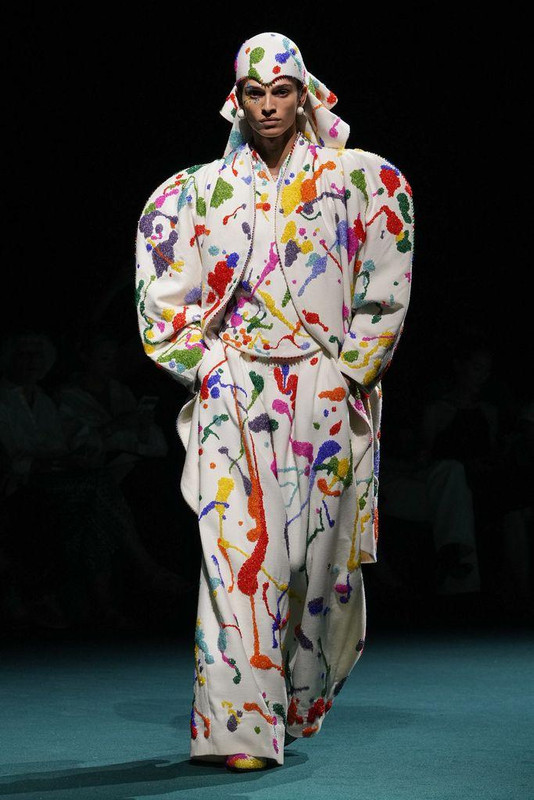
There is no doubt that I am not a woman who takes a liking to inflated silhouettes or exaggerated shoulders. The oversized styles do not amuse me. Still, something about Robert Wun’s collection left me feeling rather emotional. Child’s Play entered the runway with a sleek charisma that silenced its audience. Instantly drawing eyes to the colourful couture stood before us, each look was something new, something more fascinating than before. Naturally, I could not guess what look would be next, and that is the beauty of this Robert Wun. With every collection, there are similarities, yet nothing is ever the same.
Crowning Wun as the king of sculptural fashion, he knew exactly what he was doing with this collection. Highlighting the purity of youth through varied hues and the complexity of the journey to adulthood through memory and experience has never been clearer. My jaw remained on the floor throughout this show. Each look introduced a new character: a textured grey rabbit, an ethereal ballerina, or a whimsically inflated cluster of balloons. To understand fashion is to have that sense of creativity that gets questioned. Tapping into his surrealist fantasy, Robert Wun brought beauty through meticulous craftsmanship, beading and textures, but it was the imagination that truly took over.
Schiaparelli: The Abyss
In conversation of dominating the runway, there was one designer that stole the show for me: Daniel Roseberry. After his takeover of Schiaparelli, I will admit that I was sceptical of whether he could match the brand’s interpretation of surrealist art and fashion. For the first time, I am proud to say that I was severely wrong. Each collection that Roseberry has produced for Schapirelli has taken first place in my mind, and with many above myself not thinking these looks could become any more profound, we are sorely mistaken. While Roseberry's talent was never questioned by his prior work at Thom Browne, Schiaparelli is where his creativity came to life. I really believed that Schiaparelli's Spring/Summer 2026 Couture collection was the toughest to beat, and so did Roseberry himself. Seeing how much success emerged from the spring collection, the original plan was to follow in his own footsteps. Something the atelier team was unfamiliar with doing, but the outcome of The Abyss was worth the uncertainty.
Schiaparelli is built on the unrealistic nature of fashion. Applying surrealism to fashion and making the mundane a word not known to a fashion house is a brand that knows its heritage. So, when Roseberry experienced a designer’s block, the hunt for creativity grew, and it landed on the modernisation of human creativity. Artificial intelligence is a very controversial topic. The debates AI can strike are endless, and honestly, there is never a right or wrong answer. The one thing Roseberry knows is right is that AI does not compare with a hands-on effort. The Abyss was partially born from the disruption of artificial intelligence as we face an unknown future. Joined by a surreal, sci-fi underwater voyage, the connections between the abyss translate to varied topics but will always be open to interpretation.
That is the speciality of Schiaparelli. You can know what the collection represents, but its perception is not always translated the same across an audience. While the depth of the sea is clear in blue hues, inflated tentacles and soft shades of silicon that wrapped the model’s bust, the use of thousands of hand-crafted and sewn scales to beads tells a different story. Having a hands-on outlook in fashion will forever be more powerful than anything AI can recreate. Roseberry proved this fluently throughout this collection. To be unsure of Schiaparelli is not to know the meaning of the brand. Surrealism is not just something infused into these designs; it is the identity that this fashion house uses to communicate with audiences across the world.
With Schiaparelli, each look was crafted with intent and devotion. With a passion to tell the story of the unknown, from the ocean's void to the complex reality of artificial intelligence, nothing could ever interfere with the human nature of authentic craftsmanship. Daniel Roseberry, Schiaparelli, and two conflicting narratives worked hand in hand to curate one of the most beautiful collections in history, in my view.
Elie Saab: The Ball of Untamed Dreams
Unknowingly, couture week came with a hidden message, exclusive for the designers: sculptured. Every collection that entered our view welcomed its own interpretation of refined sculpted silhouettes and daring new textures. A brand not one to be left out, Elie Saab reintroduced timeless structure to the modernised world, making her name the belle of the ball. Focusing on her traditional colour palette and divine femininity, Elie Saab did not hold back on her desire for a fairytale dream.
An ensemble of breathtaking gowns entered the runway, stealing our attention. Crafted with nothing but excellence, each look transformed the stage into a grand ballroom, with deep magenta silks, corseted waists infused with dramatic flair, and intricate headpieces crafted into living art.
It was like entering a rose garden. The show consumed the palette of a lustful midnight, surrounded by a romantic essence. Emotion accompanied these looks as roses consumed the gowns and tailored suits, masked and made for mystery. This show was a ball for the unspoken dreams, untamed and unfamiliar. Whimsical charm surrounded the show as silk draped across the floor. A rose curated by fabric applique applied a muted touch of grace, whilst pleated rouge added the aroma of yearning passion.
The contrasting innocence of silk blush with the longing desire of a velvet crimson gown was powerfully intriguing. Taking inspiration from 20th-century masquerade balls and the beauty of surrealism, Elie Saab captured concealed identities through elaborate masks, marking the undeniable intention of art in fashion. The beauty that rests in Elie Saab is one to be investigated. Despite the force of modernisation in fashion, Saab is one of the few fashion houses that remains confident in their identity. The desire to change can be overconsuming, especially in a contemporary world where staying timeless can be overlooked. Yet it is collections like these that leave the audience spiralling for more. A complex narrative is not always needed when the fashion holds its power in its presence.
With every collection hinting at surrealism and heading back to their origins, is it time we follow their lead? Passion and desire were reborn this season, and it felt better than ever. For the first time in a while, it felt as though fashion snapped back into reality. Fashion houses remembered who they are and what they stand for. No longer under the spell of a modernised world, brands are stepping back into the past with pride, power, and a whole new meaning.
As the lights dimmed in Paris, one thing was clear: couture’s future belongs to those unafraid of reinvention.