East of Eden (2026) Review: Florence Pugh and Hoon Lee are spellbinding in gritty Steinbeck adaptation
Film & TV6 October 2026
AuthorAlexandra Hill
Photos© NETFLIx
Zoe Kazan’s contemporary adaptation of the 1952 novel wanders from Steinbeck’s original moral discussion, instead rooting itself in a critique of gender and belonging.
A
dapting literary greats for screen has often become a thing of a curse for ambitious screenwriters trying to do the source material justice. Taking on John Steinbeck’s 1952 epic novel East of Eden is a different beast, with Elia Kazan’s 1955 adaptation of the novel falling victim to heavy directorial cuts despite boasting a tragically tormented James Dean at the helm.
Luckily, ambition runs in the family, with the latest adaptation from Zoe Kazan, Elia’s granddaughter, stopping at nothing short of greatness itself.
This seven-part Netflix miniseries, adapted primarily by Kazan with direction from Garth Davis and Laure de Clermont-Tonnerre, is a spellbinding family saga musing on monstrosity throughout generations of the Trask family in rural California.
Steinbeck’s novel is a gritty retelling of the biblical story of Cain and Abel, emulated through the complex fraternal relationship between Adam Trask (Christopher Abbott) and his half-brother Charles (Mike Faist), raised by their tyrannical father Cyrus (Tracy Letts). Despite favouring Adam, Cyrus enrols his son for service in the Civil War, causing an irreversible rift between the two brothers.
Kazan wastes no time in delving into this dirt. The opening scene follows a bloodied, half-dead woman crawling zombie-like to the Trask doorstep, bringing the brothers’ conflicting moral codes: naïve Adam wants to call a doctor, while distrusting Charles immediately wants the sheriff involved.
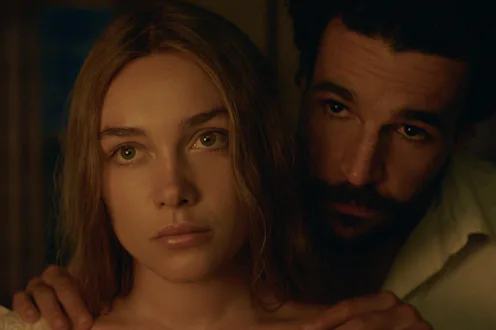
Feigning amnesia, we soon find out that the woman, Cathy Ames (Florence Pugh), is fleeing a troubled past marked by obsession and paranoia. “You’re so kind to me, and I’ll only bring you trouble,” she tells Adam, though nothing will dissuade him from picturing life with her in pastoral California, and the two quickly fall pregnant with twins.
Steinbeck stages the late 19th-century American Dream of going west to California as “paradise”, or Eden, which for Adam is in the sweeping plains of the Salinas Valley. For Cathy, meanwhile, this is a cage of patriarchal control from which she is desperate to escape.
Soon, despite Adam’s persistent disbelief, it becomes clear to Irish farmer Samuel Hamilton (Ciarán Hinds) and Chinese servant Lee (Hoon Lee) that there is an apathetic darkness within Cathy, masterfully performed by a chilling Pugh against the shadowy, desaturated cinematography of the series.
While Steinbeck’s original novel examined good and evil more acutely, Cathy’s insistence on making her own way in the world propels the series into a critique of gender and patriarchy. Although anchored by Pugh’s blank-stared psycho-sociopathy, this is perhaps where Kazan’s Cathy starts to slip—her torment becomes a product of abuse and mistreatment from an unfair society, rather than her inherent evil that Steinbeck portrays.
But not only does this allow for some seriously gritty violence to sink your teeth into, it demonstrates Kazan’s belief that monsters are made, rather than born that way. Good and evil are choices after all, per Lee, who teaches the twin boys Cal (Joseph Zada) and Aron (Joe Anders) the concept of “timshel”, a Hebrew word meaning “you may” triumph over sin.
Lee’s story of generational racial injustice and belonging is arguably the most tenderly poignant subplot of the miniseries, caught like lightning in a bottle by a completely captivating Hoon Lee.
From assuming a quasi-co-parental relationship with Adam in Cathy’s absence to discussing his mother’s tragic experience under indenture, Lee’s depth unfurls gradually, offsetting Cal and Aron’s shoehorned storyline in later episodes. “I want to be good like you and Aron,” Cal tells his father, hammering the point squarely on the nose.
For all of East of Eden’s generational sprawling, it’s a credit to Kazan for keeping Steinbeck’s wandering subnarratives from becoming a tangled mess. While a stronger examination of human nature may reside in the series’ earlier fraternal conflict, East of Eden is still a compelling piece of literary adaptation for screen that, like Steinbeck’s novel, deserves to sit among the greats.
East of Eden is now available to stream on Netflix.