Boogie Nights (1997) Review: the Rise and Fall of Silly-Sexy Stardom

On a silly-sexy journey inside the 1970s adult film industry, Anderson presents a punchy portrait of addiction and obsession as video tape begins to faze filmmaking out.
ame, family, and fragile masculinity power Paul Thomas Anderson’s tragicomic porn comedy Boogie Nights (1997), the writer-director’s second film that blazed across screens worldwide this month following a new 4K restoration.
Anderson’s portrait of the 1970s and 80s adult film industry straddles two decades, soundtracked by disco decadence, though curiously Heatwave’s 1976 “Boogie Nights” was sorely missed. But the film’s riotous fun still made it an addiction to devour.
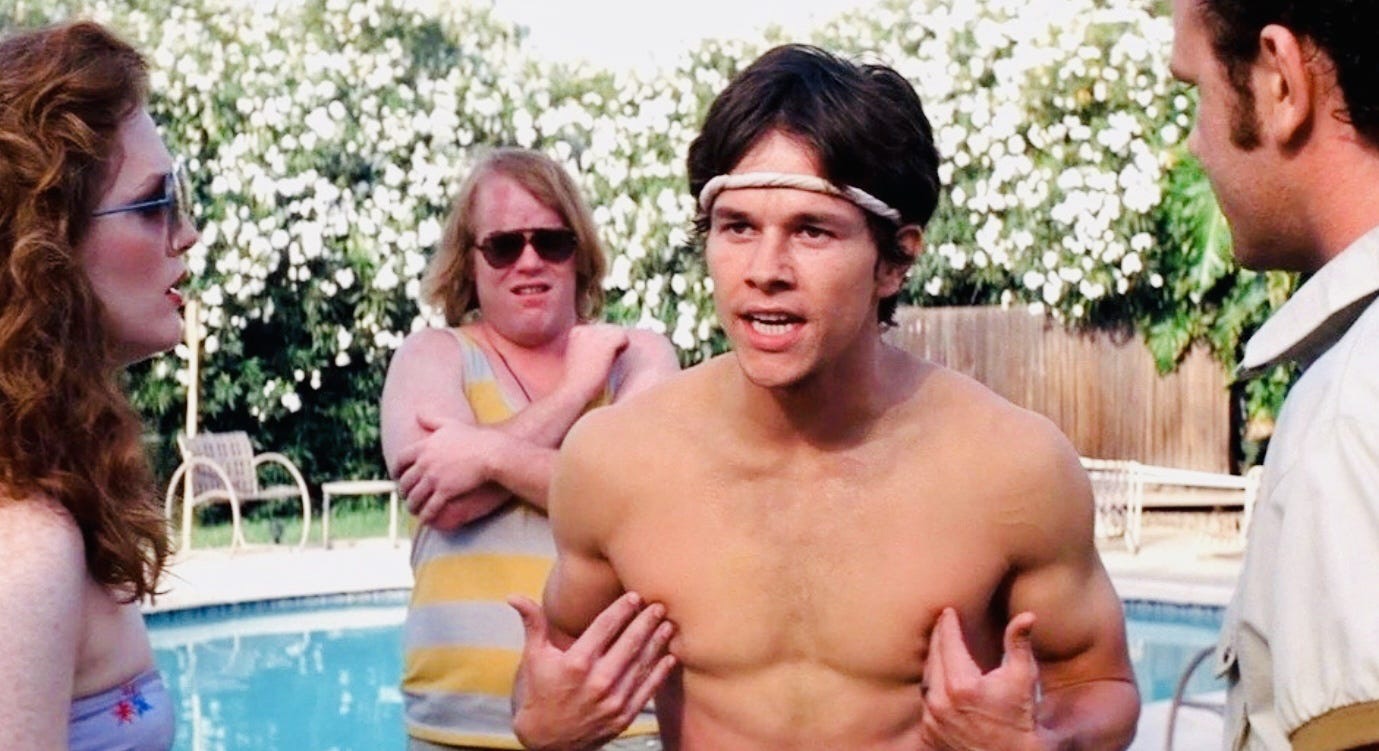
Hedonistic high-school-dropout Eddie Adams (Mark Wahlberg) works as a kitchen porter at an LA nightclub when he is scouted by silver-fox porn director Jack Horner (Burt Reynolds) to become adult film’s next young star. In fact, being the “star” becomes Dirk’s addiction as he dubs himself “Dirk Diggler”, obsessing over his performance and how sexy his “talent” is. Cough cough.
Estranged from his family home, Dirk becomes the son of a quasi-adoptive industry family in Horner’s house, including Maggie (Julianne Moore), whose foxy industry persona Amber Waves covers the shame she endures from being denied seeing her child. The two fall into a pseudo-incestuous relationship both in and out of the porn world, while Brandy (Heather Graham)---known as “Rollergirl” for never removing her roller skates---becomes something of a sister.
Parent-child relationships are a common thread connecting Anderson's films, like in his following feature Magnolia (1999), focusing on deeply dysfunctional family dynamics, or in the director's latest revolutionary thriller One Battle After Another (2025), centred on Bob (Leonardo DiCaprio) and his daughter Willa (Chase Infiniti). In fact, Leonardo DiCaprio reportedly turned down the starring role in Boogie Nights in favour of Titanic (1997), which was likely the smarter choice in hindsight.
But Boogie Nights wouldn’t be Boogie Nights without Mark Wahlburg’s silly-sexy performance, backed by an ensemble cast superbly straddling the film’s comic highs and tragic lows. Standouts are John C. Reilly as Reed, Dirk’s co-star whose fragile masculinity is undercut by his longing to be a magician, and Phillip Seymour Hoffman’s (relatively small) role as set-runner Scotty whose desire for Dirk puts him in a pit of self-hatred.
Sex and shame often go hand-in-hand, but Anderson refuses to condemn the characters we so intimately get to know. Maggie crying after the court refuses her custody grant and Scotty sobbing after trying to kiss Dirk makes for a poignant juxtaposition later in the film when Dirk escapes from a fatal altercation at a drug-dealer’s house, finally pushing him to emotional breaking point in his car ride home.
Throughout it all, Boogie Nights is infused with a white haze of cocaine, supercharging Dirk to stardom yet serving to tear his fantasy back down. Picture Brian De Palma’s Scarface (1983) or Martin Scorsese’s Goodfellas (1990), the latter cited as a direct influence on Anderson’s direction. The film is staged as a drug high: the energetic rush of success sobered up by the arrival of the 80s and video tape, threatening the future of film.


