Within the jewel-encrusted dreams of Manfred Thierry Mugler, a transcendent realm existed. Teeming with mysticism and otherworldly echoes, ‘Planet Mugler’ functioned as a fantastical utopia.
Shrouded in science-fiction, mythology, and folklore, the Mugler women were painted as ethereal, gilded creatures; semi-fictional specimens. Triggered by a lifelong love affair with the cosmos, and the rejection of reality, Thierry Mugler’s presentations submerged audiences into mesmeric unimagined worlds.
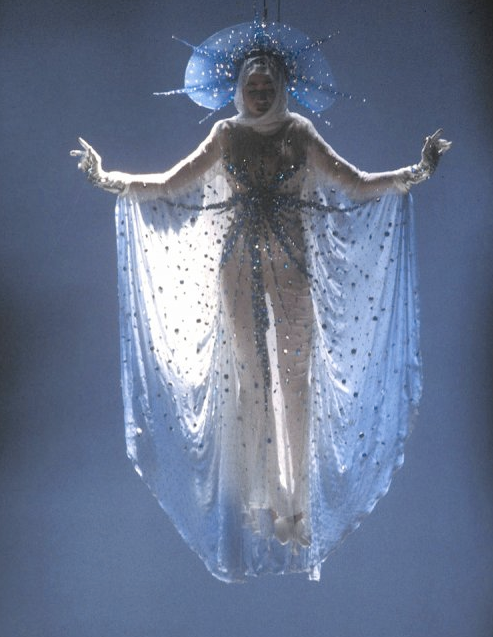
In 1984, as a tenth anniversary celebration, Mugler presented ‘L’Hiver des Anges’ – Winter of Angels – a theatrical display at Paris’s Le Zénith. Dripping with religious, celestial, and futuristic imagery, this spellbinding extravaganza was akin to an avant-garde fever dream. For the first time in French history, a fashion show was open to the public through ticketing – a monumental development. The air was infused with uncanny utopia as gilded models sporting halos, wings, and glowing platinum wigs paraded the runway with almost robotic precision. Portrayed as the Madonna, Pat Cleveland’s unearthly suspension and descension from above served as the show’s inimitable climax.
Surrealism and metamorphosis were prominent fixtures within Mugler’s later collections, as seen in his 1988 interpretation of Atlantis, the fictional advanced underwater civilisation, a further result of his enduring mythological fascination.
Beyond the revolutionary designs, Mugler gravitated towards colossal, imposing architecture when staging shows to heighten the potent ambience – a constant that equally underpinned his photography concepts.
Futurism remained the backbone of the Mugler universe with an earth-shattering 1995 twentieth anniversary spectacular cementing a glittering legacy. With an illuminated star looming above, the Cirque d’Hiver witnessed the collision of past and future. Notable ensembles included a cyborg suit inspired by the 1927 science-fiction film ‘Metropolis’, an armouresque metal bodysuit and gloves, a jaw-dropping nod to Botticelli’s ‘Venus’, and a Marie Antoinette-inspired beaded sculptural piece.
1997 can be deemed a year of metamorphosis and hybridity. Curiously entitled ‘Les Insectes’, the Spring/Summer 1997 haute couture collection imagined a fantasy in which women had bizarrely adopted insectoid features. Serving as a stark commentary on transformation, femininity, and defence, audiences were plunged into a disconcerting Mugler-induced reverie. Green and blue lighting reflected on models, imitating the iridescence littering the insect world. Disquieting music clashed with upbeat tunes and delicate instrumentals, as aposematic colouration reigned on the runway. Startling creatures emerged adorned with antennae, exaggerated sunglasses, elongated lashes, and protruding fixtures, transforming viewers into clandestine voyeurs of a sacred existence.
Thierry Mugler’s Autumn/Winter 1997 haute couture collection ‘Les Chimères’ crash-landed and concluded in explosive extravagance with one of the most expensive couture creations in history. Loosely translated to ‘mythical creatures’, ‘Les Chimères’ was a natural continuation from ‘Les Insectes’. Captivated by East Asian and Russian culture, Mugler deepened his explorations into armour, mythology, and femininity. The show-stopping finale welcomed ‘La Chimère’, an enigmatic reptilian hybrid created in collaboration with the famed Mr Pearl and Jean-Jacques Urcun. ‘La Chimère’ realised complex layers of Mugler’s fantasies in one otherworldly design.
Thierry Mugler’s ability to tap into unchartered realms rests as a luminous legacy that sharply deflated the greyscale of reality. His quest to conceptualise intangible worlds irreversibly distorted the zeitgeist of the late twentieth century.