Japanese Horror at FrightFest 2026: “Humiliation Liberates You Into Who You Need to Be”
Film & TV2 September 2026
AuthorAlexandra Hill
Through gore, existential dread, and sexual perversion, FrightFest’s selection of Japanese horror and sci-fi outlines how Hollywood can be torn down and rebuilt again by weird cinematic satire.
A
mong the weird and wonderful array of premieres and international horror debuts at FrightFest 2026 is a pocket of Japanese horror filmmaking that stops at nothing short of bizarre.
From existential psychological dread to the fetishization of sexual perversion and headless zombies, this year’s Japanese horror showcase was an exercise in stomach strength. But beneath the bizarre lies a superbly witty allegorical critique of Japan’s history of mass destruction, political activism, and the postwar Japan-US relationship.
“Once you’re at your lowest you just rebound and build yourself up again,” explains Tom Mes, author of this year’s FrightFest Guide to Japanese Horror Movies. We spoke to Mes between screenings of Hirohisa Sasaki’s Crazy Lips (2000) and its sequel Gore From Outer Space (2001), which he describes as “sex comedies as much as horror films of the kinky kind”.
Japanese Horror, Sex and Humiliation
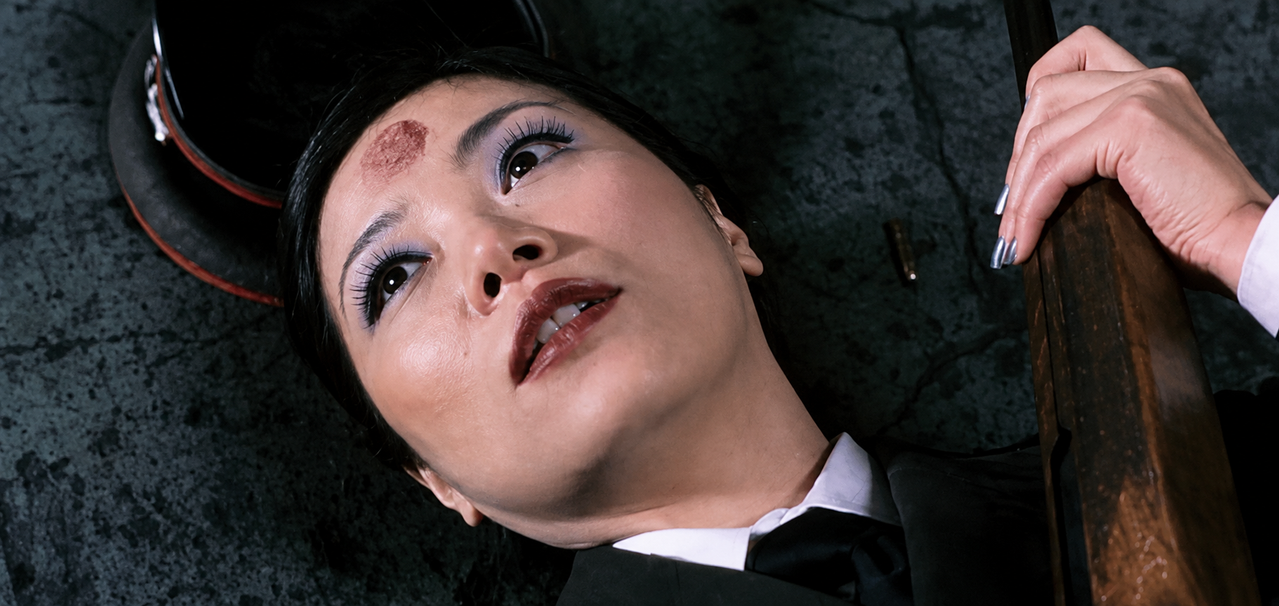
Kinky may be an understatement. In Crazy Lips, Satomi (Hitomi Miwa) is desperate to prove her brother’s innocence after he is accused of beheading four young girls, so she decides to go to a psychic (Yoshiko Yura) for help. Instead of money, however, the price her family has to pay quickly devolves into non-consensual sex fantasy, necrophilia, and incest.Crazy Lips blurs the line between Japanese softcore sex filmmaking, or “pink” filmmaking, and gore, showing the intersection of sexual lust and blood lust that supercharged psychosexual hits like Jane Schoenbrun’s Teenage Sex and Death at Camp Miasma (2026) recently released last month.
“Certainly in the case of Crazy Lips, the humiliating sexual act liberates you into the person you need to be,” says Mes, alluding to Japan’s continued experience of devastation, “Everything has been wiped away, so you can rebuild it into something new. Japan has experienced so much mass destruction from natural disasters and attacks that it has always had to rebuild itself”.
Japanese film buffs may immediately think of Otomo Katsuhiro’s post-apocalyptic techno-cyberpunk Akira (1988), juxtaposing chaotic body horror painted in red hues with the screen whiting out twice as two atomic bombs reduce Neo Tokyo to rubble, from which an ambition to rebuild emerges.
How Japanese Horror Rebuilds From Destruction
Akira was revolutionary in resurfacing Japan’s repressed history of political militarism and traumatic devastation. This also rings true in the case of Godzilla (1954), which, despite seeing enormous success in the US for monster action (and merchandising…), was made primarily for a Japanese audience who had so recently witnessed widespread devastation on their doorstep.For Mes, Ishiro Honda’s Godzilla is metaphorical for the various attacks that Japan experienced at the end of the Second World War, including the two atomic bombs dropped on Hiroshima and Nagasaki. This then led to the postwar Japan-US security pact, whose legacy and influence takes on a satirical sci-fi spin in both Crazy Lips and Gore From Outer Space.
After surpassing its psychosexual absurdity, Crazy Lips draws to a rampant axe-murdering head (acutely undercutting the Western slasher genre), but now the characters must contend with a new threat: aliens.
America, Aliens and Gore From Outer Space
Then, in Gore From Outer Space, Satomi (Aimi Nakamura) is forcibly penetrated by an alien while searching for her kidnapped daughter, only to find that now she must bear a “mixed-blood” baby, introducing a racial charge to the film’s nonsensical comedy. Meanwhile, two “FBI” agents are on the case, whose hardline humorlessness is undercut by poor American accents and a silly blond wig.
“You can read the coming of America as an allegory for the alien invasion [in both films],” offers Mes, with Sasaki’s hodge podge of horror, sci-fi, action, and softcore cinema therefore culminating in a cinematic parody of both Hollywood, as well as ideas around whiteness and Westernisation.
In fact, cinematic satire appears a running theme for Japanese screenings at FrightFest 2026, with Makoto Ueda’s directorial debut You Are The Film (2026) similarly descending into genre-bending chaos.
Less horror than it is sci-fi silliness, You Are The Film engineers a cinematic “multiverse” in which Madoka (Marika Ito) goes to the cinema to watch a film no one else wants to watch for lack of understanding, and finds that her life is a film for Kazuma (Kai Inowaki) watching from the other side of the screen.
You Are The Film Tears Apart the Rules of Cinema
You Are The Film is a clever gimmick sorely undercut by its low budget and fraying writing, especially when aliens arrive and gang-war violence breaks loose in a blink of an eye. But the main shtick is that we, as viewers, could be in a filmic world for someone else, and could at some point be confronted with the fact that our reality is all an illusion. Very Black Mirror (2011-present), if you take out the dystopian horror part.But can we expect anything less from Japanese filmmaking than ripping apart the fabric of cinema itself? If anything, FrightFest’s selection this year shows that the dominant Western convention is mortal, and can be torn down and rebuilt by Japanese weirdness.