A Life in Books: Dolly Parton’s Favourite Books and Literary Legacy
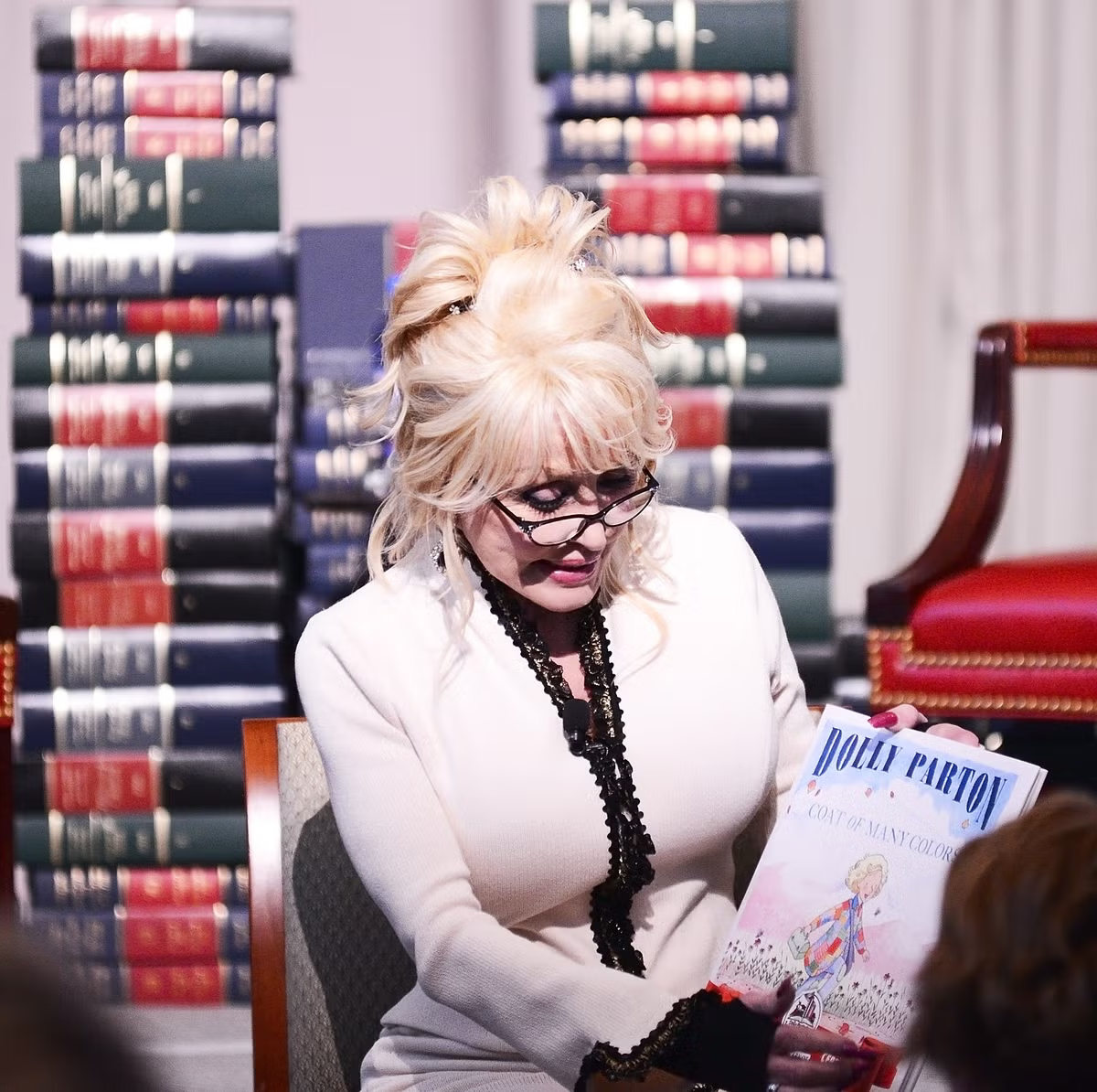
Dolly Parton was more than a country music icon. A voracious reader and lifelong champion of literacy, her favourite books reveal the stories that shaped a remarkable life.
T
here are few people who seem to have lived quite as many lives as Dolly Parton. Singer, songwriter, actress, businesswoman, theme park founder, philanthropist, style icon. Though beneath the big hair, bigger personality, and the unmistakable voice was something perhaps even more important to Dolly: a deep and lifelong love of books, both those she read herself and those she helped put into the hands of millions of children.
Her love stretched beyond her own bookshelves in 1995 when Dolly launched the Imagination Library, a book-gifting programme which, according to the organisation, was inspired by her father who was “the smartest man I have ever known but I know in my heart his inability to read probably kept him from fulfilling all of his dreams”. The programme sends free, high-quality books to children from birth to the age of five, regardless of their family’s income, with the hope that every child can experience the magic, comfort, and possibility that comes from having a book of their own.
And Dolly practiced what she preached. In 1981, she told listeners of The Ralph Emery Show that she reads “all the time, at least 50 or 52 books a year”, and later explained that she never saw reading as an obligation, but rather a pleasure, and one that she was more than happy to share with everyone around her. She has spoken about discussing the books she was reading with friends, family, and frankly, anyone who would listen, turning reading into something communal rather than solitary.
What Were Dolly Parton's Favourite Books?
Her favourite books reveal a reader drawn to historical fiction as a primary genre, sweeping stories, complicated characters, and the strange, funny, and often heartbreaking experience of being human. These are the top five books that Dolly recommended to offer a glimpse into her imagination.
Water for Elephants by Sara Gruen
Sara Gruen’s Water for Elephants takes readers into the world of a travelling circus during the Great Depression, following Jacob Jankowski as he joins the Benzini Brothers circus and becomes caught up in its complicated web of performers, animals, love and violence.
It is a book about reinvention and survival, but also about the unlikely communities we find ourselves belonging to.
The Count of Monte Cristo by Alexandre Dumas
If there is one thing Dolly clearly appreciates, it is a good, dramatic story, and Alexandre Dumas certainly delivers one.
The Count of Monte Cristo is the ultimate tale of betrayal, imprisonment, escape and revenge, following Edmond Dantès after he is falsely imprisoned and devotes himself to destroying the people responsible.
At more than a thousand pages depending on the edition, it is not exactly a light weekend read, but Dolly’s love of the novel is perhaps a reminder that her claim of reading around 50 books a year is not necessarily a race to read as many as she can, but a genuine enjoyment that continually provokes her to pick up another book. She appears to read for the sheer pleasure of disappearing into a story, and few novels offer quite such an elaborate place to disappear into as Dumas’ epic.
Black Mountain Breakdown by Lee Smith
Lee Smith’s Black Mountain Breakdown is a collection of stories centred around the fictional town of Black Mountain, North Carolina, exploring the lives of the women who inhabit it.
The book is filled with the kinds of characters who feel larger than the pages they occupy: funny, flawed, lonely, resilient and deeply human. It is also rooted in the landscape and culture of Appalachia, making Smith’s work an especially interesting choice for Dolly, whose own storytelling has so often drawn on the people, places and traditions of the Appalachian South.
The Grapes of Wrath by John Steinbeck
John Steinbeck’s The Grapes of Wrath is perhaps the most obvious reminder that Dolly’s love of books extends far beyond easy escapism.
Set during the Great Depression, the novel follows the Joad family as they are forced from their Oklahoma home and travel west to California in search of work and a better life. It is a story of poverty, displacement and exploitation, but also one of family, endurance and solidarity.
Those themes of family, hardship, and the determination to keep going have long appeared in Dolly’s own storytelling. Her songs have often given a voice to people living on the margins, particularly working-class families and women, and Steinbeck’s ability to find dignity in lives shaped by economic hardship feels like a natural fit for a reader with Dolly’s particular worldview.
Big Stone Gap by Adriana Trigiani
Finally, there is Big Stone Gap, Adriana Trigiani’s warm and funny novel about Ave Maria Mulligan, a pharmacist living in the small Appalachian town of Big Stone Gap whose life is turned upside down following the death of her mother.
It is a celebration of small-town life and the eccentric characters who make a place feel like home. Of all Dolly’s favourites, perhaps this one feels the closest to her own storytelling instincts. Trigiani writes about the importance of knowing where you come from while still allowing yourself to imagine somewhere, and someone, differently. It is a book about discovering that your life can change even when you thought you already knew exactly what it was.
Dolly Parton is proof that one person’s love of books can become something so much bigger.
Since 1995, the Imagination Library has gifted more than 330 million books to children around the world, making Dolly’s literary legacy every bit as remarkable as her musical one. The most beautiful part of this legacy is what each book represents: a child opening the package, discovering a new world, and realising that their own story might be bigger than they ever imagined.
For a woman who spent her life teaching us to dream, there could be no more fitting legacy than leaving a world full of children with stories to dream about.