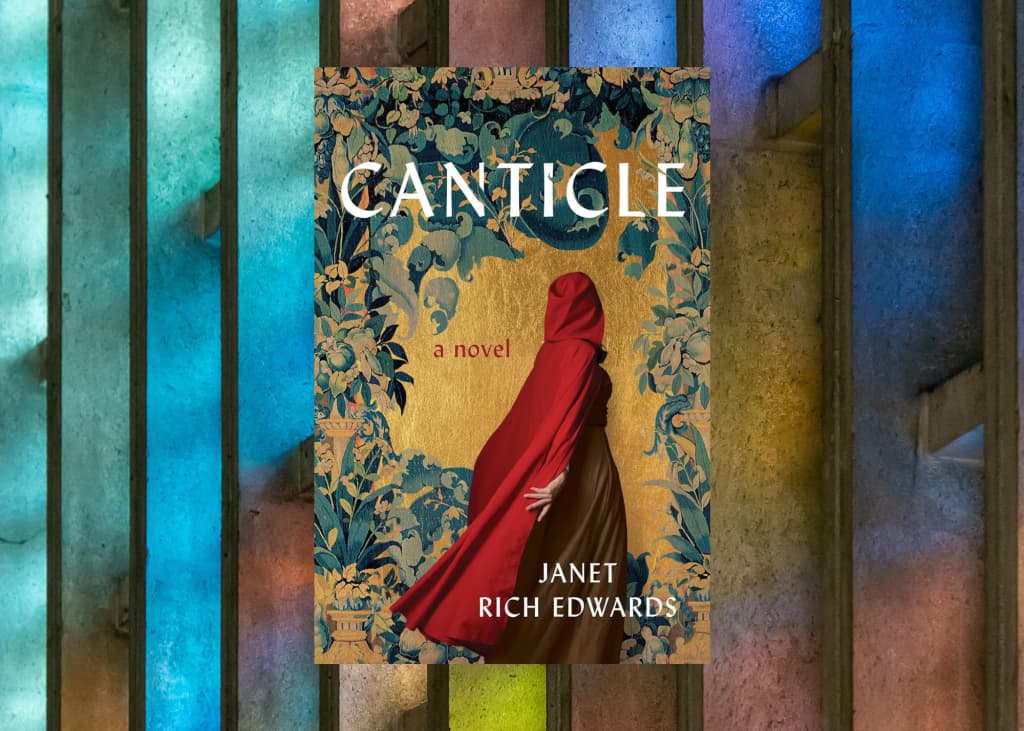
Canticle by Janet Rich Edwards: Book Review and Analysis
Historical fiction novels can oftentimes feel artificial. Either they’re overly modern or so focused on historical detail that the story itself disappears. Canticle avoids both of these problems
By Jocelyne Dellaud
Historical fiction novels can oftentimes feel artificial. Either they’re overly modern or so focused on historical detail that the story itself disappears. Canticle avoids both of these problems. Janet Rich Edwards creates a world that feels fully alive. What I enjoyed about this book was that the setting never came across as a caricature of the medieval era; the setting felt genuinely inhabited. From the religious life to the streets and daily routines, the novel immerses you in 13th century Bruges in a way that feels absolutely natural. That atmosphere is one of the book’s greatest strengths.
Canticle follows Aleys, a young girl struggling with faith, grief, and her desire for purpose in a world that gives women very little freedom. I enjoy that the author wasn’t afraid to make her deeply flawed. She is proud, impulsive, naïve, sincere, and constantly searching for meaning, often all at once. Edwards allows those contradictions to exist without trying to smooth them out. This makes Aleys feel more like an actual person.
The prose is another standout. Edwards writes with a lyrical, luminous style that fits the story perfectly. There are moments where the writing feels genuinely beautiful, especially in scenes centred around faith and devotion. Edwards is also especially good at depicting the seduction of martyrdom — the way suffering and holiness can become tangled together in someone’s mind. The novel treats spirituality seriously, which gives it a sincerity that feels refreshing. I also appreciated how unique the setting and concept were. Medieval religious communities, particularly the beguines, are not something most novels focus on, and that gives Canticle a distinct identity. The premise immediately stands out because it explores a world and perspective that feels unfamiliar to most readers. It’s not often that an author chooses to write about 13th century Bruges so that unique choice of era gives the novel an edge.
At the same time, the pacing is probably the book’s biggest weakness. The novel moves very slowly, and not always in a way that allows the reader to fully settle into the story. A lot of time is spent circling Aleys’s internal struggles, and after a while those moments begin to feel repetitive. I found myself wishing the book spent more time developing the relationships early on, especially Aleys’s family dynamic and her friendship with Finn. Those relationships had emotional potential, but the novel often summarises them instead of fully letting us live inside them. There are stretches where the story leans too heavily on exposition and telling rather than showing.
Even with those issues, Canticle is an impressive debut. The pacing drags at times, but the atmosphere, prose, and emotional sincerity make it worth reading. I’d recommend it to readers who enjoy immersive historical fiction and character-driven stories about faith, identity, and devotion. It’s the kind of debut that feels ambitious in a genuine way, and that ambition mostly pays off. Overall, I would give Canticle 3 out of 5 stars.
Readers who value atmosphere and character over plot momentum will likely find much to admire here.


Cherub Magazine
Subscribe to our newsletter
Conversation
Comments
Loading comments...